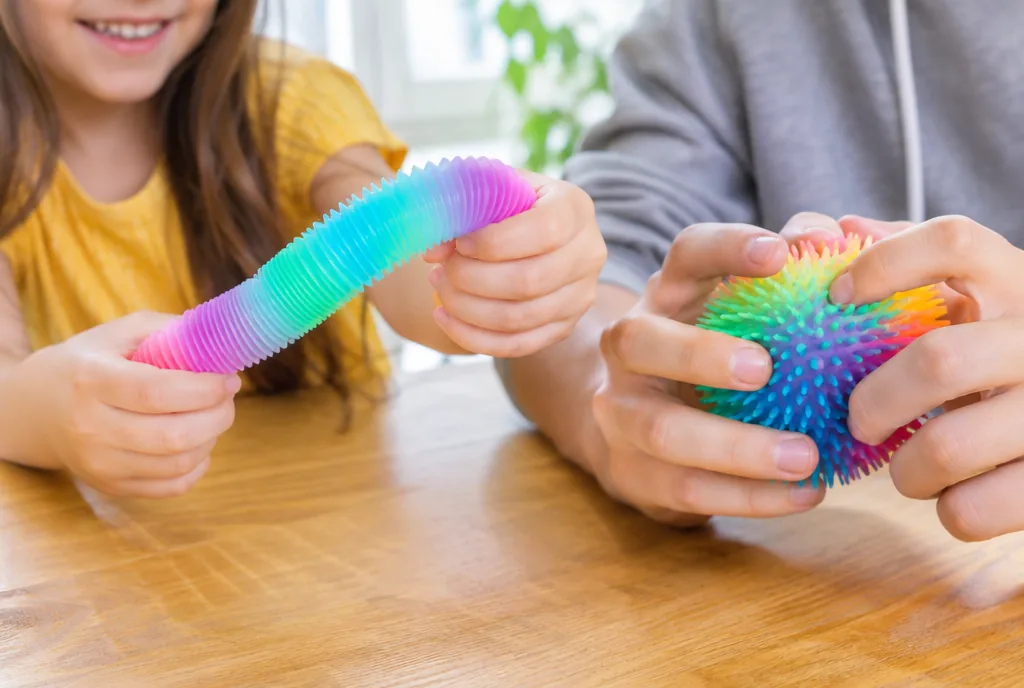
Sensory therapy, usually called sensory integration therapy, is a play-based form of occupational therapy for children who struggle to handle sensory input such as noise, touch or movement. It is often used for autistic children, but also for children with developmental delays, ADHD or coordination problems. This article explains what happens in a session, who provides the therapy, how families pay for it, and what the research shows.
Key points
- Sensory therapy is a play-based occupational therapy for children who struggle with sensory input.
- It is often used for autistic children and for those with developmental delays, ADHD, or coordination problems.
- Therapy targets vestibular, proprioceptive, tactile, and increasingly interoceptive senses.
- Sessions typically last 45–60 minutes and follow check-in, warm-up, main challenge, table task, and calm-down.
- Occupational therapists use equipment like swings, crash pads, ball pits, climbing walls, and sensory bins.
The senses sensory therapy works with
Occupational therapist A. Jean Ayres, who developed sensory integration theory in the 1960s and 1970s, focused on three “body-centered” senses that people rarely think about but rely on constantly.
Vestibular sense: balance and movement
Receptors in the inner ear register head position, speed and direction. Swinging, spinning, rolling and riding a scooter board all engage the vestibular system. A child who is under-responsive may crave movement; an over-responsive child may fear stairs, playground equipment or having the feet off the ground.
Proprioception: muscles and joints
Sensors in muscles, tendons and joints tell the brain where the body is and how much force it uses. Pushing, pulling, carrying and climbing provide strong proprioceptive input, which many children find calming and organizing.
Tactile sense: the skin
The skin registers pressure, texture, temperature and pain. Children with tactile over-responsivity may avoid glue, sand or certain clothes; under-responsive children may not notice a dirty face or a scraped knee.
Interoception
Therapists increasingly pay attention to interoception, the sense of signals from inside the body such as hunger, thirst, heartbeat and the need to use the bathroom. Difficulty reading these signals can affect toilet training, eating and emotional regulation.
Inside the sensory gym
Sensory integration therapy usually takes place in a room built for movement. Typical equipment:
| Equipment | Main senses involved |
|---|---|
| Platform swing, tire swing | Vestibular, proprioceptive |
| Net or lycra swing | Vestibular, tactile |
| Crash pads for jumping and falling | Proprioceptive, vestibular |
| Ball pit | Tactile, proprioceptive |
| Climbing wall or rope ladder | Proprioceptive, vestibular, tactile |
| Scooter boards and ramps | Vestibular, proprioceptive |
| Therapy balls | Vestibular, proprioceptive |
| Bins with rice, dried beans or sand | Tactile |
The equipment is hung from ceiling hooks and surrounded by mats so the therapist can adjust height, speed and difficulty safely.
A typical session, step by step
Sessions usually last 45 to 60 minutes. Every session is individual, but many follow this rhythm:
- Check-in. The therapist asks about sleep, meals and the last few days and reviews the goal for the day.
- Warm-up. Jumping on a trampoline, swinging or pushing a heavy ball helps the child get “ready to work.”
- Main challenge. For 20 minutes or more the child works on a task linked to the goals: climbing a wall to reach a swing, planning an obstacle course, or catching bean bags while swinging.
- Table task. Many sessions include a fine-motor activity such as drawing, cutting or building, to see whether the child can carry calm and focus into seated work.
- Calm-down. Slow swinging, deep pressure under a heavy cushion or breathing games lower arousal before the child leaves.
- Parent debrief. The therapist explains what happened, what worked, and what to try at home that week.
The “just-right challenge”
At the heart of Ayres’ approach is the just-right challenge: an activity hard enough to require effort but easy enough to succeed. When the child manages it, therapists call the result an adaptive response, a purposeful, organized action such as figuring out how to climb onto a moving swing.
To the child, therapy looks like play. The child often picks the activity, and the therapist quietly shapes it: raising the swing a few inches, adding a step, or slowing things down. That mix of child-led play and therapist structure is what separates sensory integration therapy from a free play session at a trampoline park.
Who provides sensory therapy
Sensory integration therapy is delivered by licensed occupational therapists. Many have post-graduate training in Ayres Sensory Integration, for example through the CLASI certificate program. Families find services in three main settings:
- Outpatient clinics and private practices, often with a full sensory gym.
- Early intervention for children under 3, provided under Part C of the Individuals with Disabilities Education Act (IDEA), usually at home or in child care. Each state runs its own program; a pediatrician or the family can make a referral.
- Schools, where OT is a related service in a child’s Individualized Education Program (IEP). School OT focuses on what the child needs to take part in class, such as handwriting, sitting tolerance or coping with noise.
Cost and coverage
- Private health insurance often covers outpatient OT with a physician’s referral and documented functional need. Plans commonly limit the number of visits per year or require prior authorization.
- Medicaid and CHIP cover medically necessary OT for eligible children; details vary by state.
- Early intervention and school-based OT are provided at no cost to families as part of IDEA services.
It helps to ask the clinic in advance how therapy will be coded and billed, because some insurers decline claims labeled only as “sensory integration.”
How parents take part
- Watch sessions, or parts of them, to learn how the therapist sets up activities.
- Ask for a written home program with a few concrete activities, how often to do them, and safety notes.
- Build activities into existing routines: carrying the laundry basket, a bath-time texture game, a trip to the playground on the way home.
- Tell the therapist what happens at home and school; those reports guide the next steps.
What the evidence says
The American Academy of Pediatrics’ 2012 policy statement noted that research on sensory integration therapies was limited and inconclusive and urged families and clinicians to set measurable goals for any trial of therapy. Since then, systematic reviews have found support for Ayres Sensory Integration in autistic children when it is delivered by trained therapists and aimed at individual goals, such as dressing or self-care. The evidence is weaker for isolated sensory techniques, such as brushing or weighted vests, used without a full assessment and plan.
Signs therapy is helping, and when to rethink it
Therapy is on track when agreed goals are met or show steady progress, and when the child takes part more easily in daily routines like getting dressed, meals, play and school. It is time to review the plan if there is no measurable change after the agreed period, if new problems appear, or if the child loses skills. In that case, a check-in with the pediatrician or a developmental specialist is the right next step.
Frequently Asked Questions
How often do children go to sensory therapy?
Usually once or twice a week, sometimes three times for a short intensive period. The frequency depends on the goals and what insurance or the school plan allows.
Is sensory therapy only for autistic children?
No. It is also used for children with developmental delays, ADHD, developmental coordination disorder or sensory difficulties without another diagnosis. The research base is strongest for autistic children.
Can parents do sensory activities at home without a therapist?
Everyday play such as swinging, climbing and carrying is good for any child. A structured program, especially brushing or weighted items, should be set up by an occupational therapist.
Does a child need a diagnosis to get OT?
Insurers usually require a referral that documents a functional problem. Early intervention and schools do their own evaluations to decide eligibility.