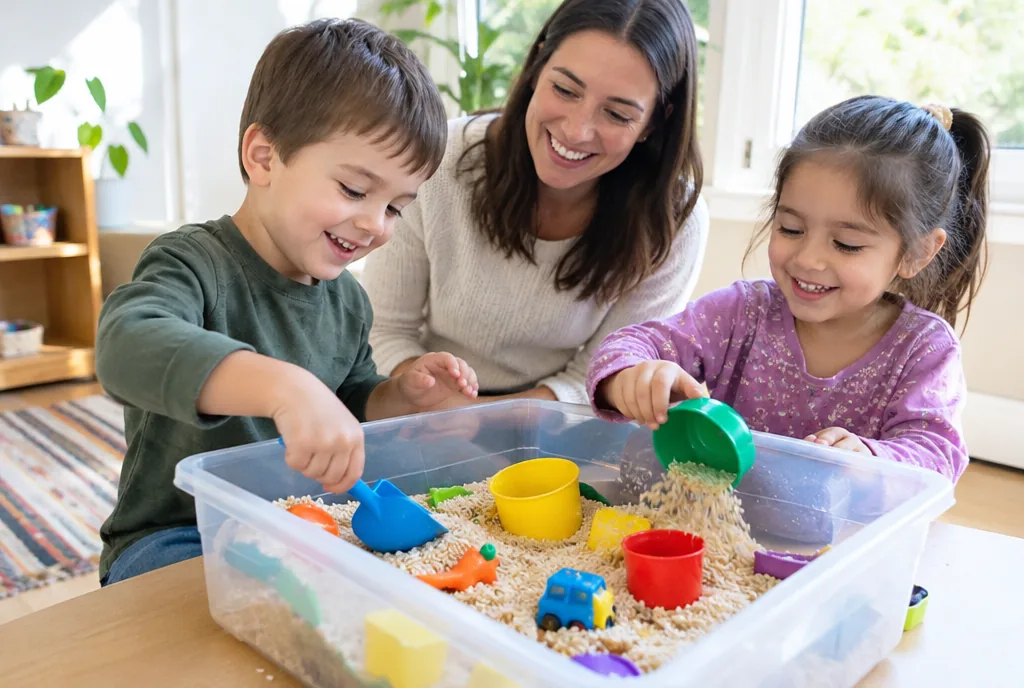
Sensory toys for autism are tools that provide a specific kind of input, such as touch, movement, deep pressure, visual interest, or sound, to support a child’s self-regulation. The useful question is not “Which toy is best?” but “What input helps this child take part in this moment?” A moldable-sand break before homework, a resistance band under a school chair, or a quiet chew tool during a long car ride can each serve a different purpose. The best choice starts with the child’s response, not a trend or a crowded shopping cart.
What sensory toys for autism can help with and what they cannot do
Sensory toys are not one category of miracle products. They are everyday tools that deliver tactile, vestibular, proprioceptive, visual, or auditory input. Tactile input comes through the skin and hands. Vestibular input comes from movement and the body’s position in space. Proprioceptive input comes through muscles and joints, often as resistance or deep pressure. A child may use that input to settle, wake up, take a break, or stay engaged with an activity.
Sensory differences are part of the DSM-5 diagnostic criteria for autism, but they are not required for an autism diagnosis. In a large CDC ADDM Network data set covering 25,627 children ages 4 and 8, 74% of autistic children had documented sensory features. That number is a reason to pay attention to sensory needs, not a reason to assume that every autistic child wants the same tool.
A toy can support participation in the moment. It does not diagnose autism, cure autism, or replace individualized care. One child may find a firm lap pad grounding before a lesson; another may pull away from that same pressure. Even a tool that works well at home may be too distracting in a classroom. The goal is a better fit between the child, the setting, and the task.
Start with sensory seeking or avoiding, not a shopping list
Before choosing toys for autistic kids, watch what happens around ordinary sensations. Sensory processing differences can include hyperreactivity, hyporeactivity, and sensory seeking or craving. These are patterns of response, not labels you need to assign at home.
- A sensory seeker looks for more input: movement, pressure, resistance, or interesting textures. A child who presses hard into cushions, keeps moving, or seeks intense textures may respond to a body sock, a chair resistance band, or moldable sand.
- A sensory avoider becomes overwhelmed more easily and may need gentle, controlled input. A noisy, busy, or scratchy option can make a hard moment harder.
- A child who seems under-responsive may notice touch or sound less readily than peers. Observation matters here too: more input is not automatically better.
Try one change at a time. For example, if after-school transitions are rough, offer a five-minute visual pause with a liquid motion bubbler for several days. Notice whether the child approaches it, turns away, settles, or becomes more activated. Then compare that response with a movement option such as rocking. A simple note about what happened before, during, and after use is more helpful than guessing from the product label.
When sensory patterns interfere with daily routines, school participation, sleep, eating, safety, or emotional well-being, bring those observations to an occupational therapist or doctor. They can help you sort out whether a tool is appropriate and how it fits into broader support.
Match the toy to the kind of input the child is looking for
A useful sensory toolkit contains a few clear options rather than a pile of unrelated autism toys. The table below connects common sensory tools with the kind of input they offer and a practical way to try them.
| Input | Examples | A practical use |
|---|---|---|
| Tactile | Moldable sand, therapy putty, textured balls, slime, fidget cubes | Offer a hand activity during a waiting period or a short break. |
| Vestibular | Pod or hammock swings, rocking toys, balance boards, spinning seats | Use planned movement when the child is seeking motion or needs a reset. |
| Proprioceptive | Weighted lap pads or blankets, compression clothing, resistance bands, trampolines, body socks | Choose resistance or pressure for a child who seeks muscle-and-joint input. |
| Visual | Lava lamps, liquid motion bubblers, light projectors, calm-down bottles | Create a brief visual pause away from a demanding activity. |
| Oral-motor | Food-grade silicone chewelry in different resistance levels | Give a safer alternative when a child chews clothing, pens, or fingers. |
Tactile choices are often the easiest place to begin. Moldable play sand stays soft, does not stick to hands, and does not dry out, which can make it appealing to a child who dislikes the roughness of ordinary sand. Therapy putty, textured balls, slime, and a fidget cube offer different hand sensations. Put out one option with a defined activity, such as rolling three balls of sand before snack, instead of demanding that the child use it for a long time.
For proprioceptive input, active resistance can be as useful to test as passive weight. A resistance band looped around chair legs gives the feet something to press against while seated. A body sock lets a child move against the resistance of stretchy fabric and receive whole-body input. It must be supervised, and the child must be able to get out independently. Those details matter more than whether the item looks “sensory” on a shelf.
Calming sensory toys can use pressure, movement, or a visual pause
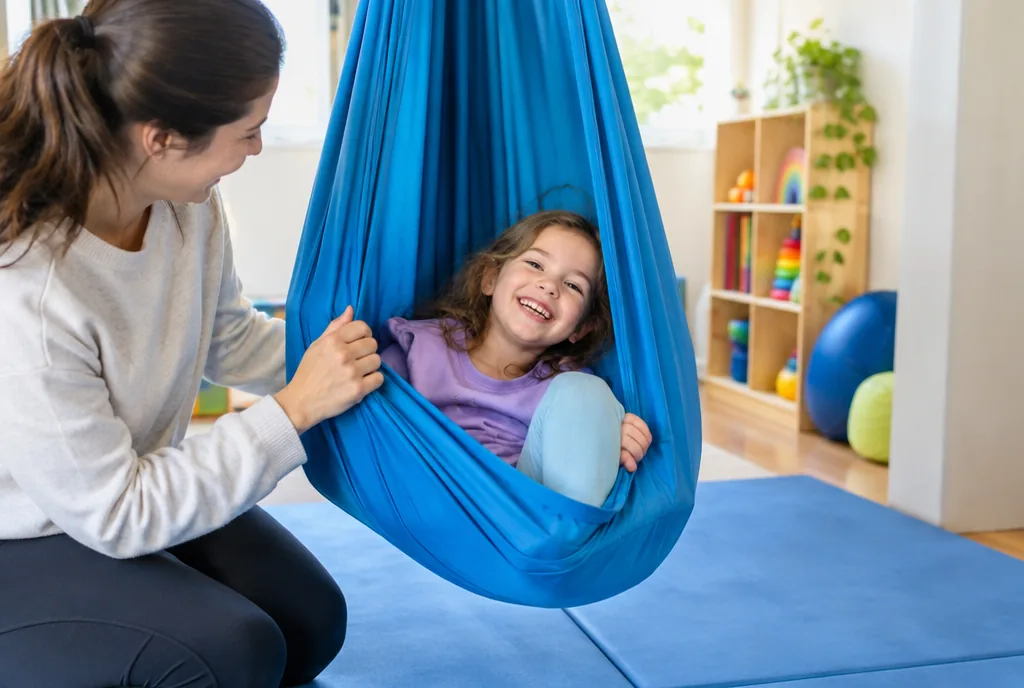
“Calming” does not mean stillness for every child. Some children settle through deep pressure, while others settle through controlled movement or a predictable visual focus. A pod swing is a useful example of why categories can overlap: when wrapped snugly, it combines vestibular movement with 360-degree deep pressure. A hammock swing, rocking toy, balance board, or spinning seat offers movement input in a different form.
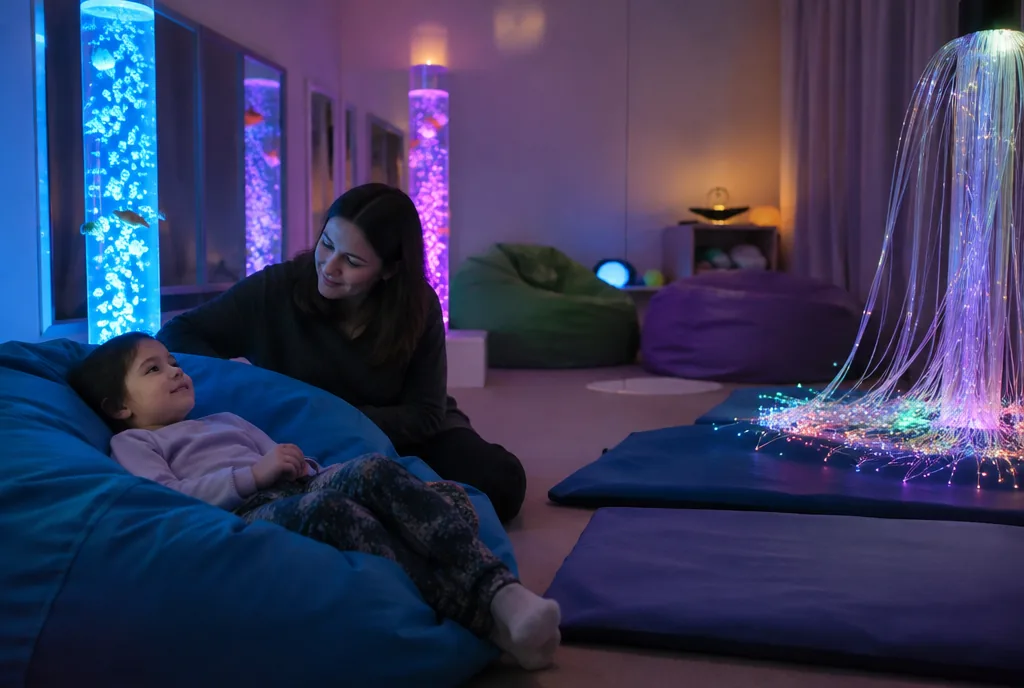
Visual tools can create a small, bounded break. Lava lamps, light projectors, calm-down bottles, and liquid motion bubblers offer slow-changing visual information. A liquid motion bubbler can give a child a five-minute break from stimming. That does not make stimming a problem to eliminate; it simply gives some children another way to pause and refocus when they want or need one.
Deep pressure is a form of proprioceptive input. Weighted blankets have the strongest evidence base among proprioceptive deep-pressure tools, and compression garments are also rated at the highest tier in an occupational therapy ranking. A weighted stuffed animal provides gentle, localized pressure and can be a comforting transition object for a younger child, but it is less therapeutically potent than a full-body blanket. Choose the smallest intervention that fits the moment: a lap pad at a desk is different from a blanket used during rest.
For a portable option, weighted lap pads of 2 to 5 pounds sit on the thighs. A common guideline for a weighted blanket is about 10% of the child’s body weight, but that recommendation can vary with the child’s sensory profile and should be discussed with an occupational therapist. Weight is not a universal calming strategy, and it is never a substitute for watching the child’s actual response.
Fidgets and chewelry are tools, not a classroom cure
Fidgets are among the most visible sensory toys for kids with autism, yet the research calls for modest expectations. A fidget cube has six surfaces for clicking, sliding, and rolling. Chain fidgets are a quiet, discreet alternative to fidget spinners and can suit classrooms for children age 8 and older. These features may make an item easier to use without disrupting others, but they do not guarantee attention or learning.
A 2025 meta-analysis of 10 classroom studies with 509 participants found a negligible overall effect for fidget devices on academic performance and behavior. A separate study of elementary students with autism found that fidgets did not improve attention or story learning. Use a fidget as a personal option, not as a classroom-wide intervention or a replacement for established, evidence-based supports.
Chewelry addresses a more specific need. Food-grade silicone chew jewelry provides oral-motor proprioceptive input and is safer than chewing clothing, pencils, or fingers. It comes in light, medium, and heavy resistance levels, which should match the child’s bite intensity. Check that the material is free of BPA, phthalates, and latex. If chewing becomes intense, causes injury, or raises a safety concern, consult an occupational therapist or doctor rather than simply offering a tougher chew.
Choose sensory toys by age and the routine you need to support
Age affects safety, but routine affects usefulness. Sensory toys for toddlers should have no small parts because of choking risk. For ages 2 to 4, textured balls, large safe putty, and simple cause-and-effect toys are appropriate starting points. A toddler may use a textured ball for a brief roll-and-squeeze game rather than an open-ended bin of small fidgets.
For school-age children from 5 to 12, quiet and discreet options are often easier to use in shared spaces: chain fidgets, fidget cubes, moldable sand, and putty. A child may prefer moldable sand after school and a chain fidget during a seated classroom task. For teens and adults age 13 and older, professionally appropriate fidgets, more complex therapy putty, and stress-relief tools can fit work, study, or travel routines.
- Pick one likely match for the routine: a chew tool for a car ride, a resistance band for seated work, or a visual tool for a transition.
- Set a short, predictable trial instead of expecting an all-day solution.
- Watch for a clear change in comfort, engagement, distraction, or distress.
- Keep the tools that fit. Rotate two or three well-matched options to preserve novelty while leaving familiar favorites within reach.
Two or three fitting tools are more valuable than a room full of possibilities. A smaller choice set also makes it easier for you and the child to recognize what is actually helping.
Use weighted and movement tools with clear safety limits
Safety is part of choosing, not an afterthought. Follow age guidance and check every item for small parts that could create a choking hazard. Supervise body socks and pod swings; before use, make sure the child can get out independently. With any swing or movement tool, use it in a setting where an adult can observe rather than assuming a calm-looking activity is risk-free.
Weighted tools are not appropriate for every child. Do not use them for a child with tactile defensiveness, certain medical conditions, or proprioceptive avoidance without guidance from an occupational therapist or doctor. A child with epilepsy, breathing conditions, or circulatory conditions should use weighted tools only after medical consultation. Stop a tool if it appears to increase distress rather than support regulation.
The Wilbarger Deep Pressure and Proprioceptive Technique is another area where professional instruction matters. The protocol uses a soft plastic brush with firm pressure from the arms down to the feet, avoiding the face, chest, and abdomen. An occupational therapist must teach it; incorrect use can worsen sensitivity. A home product description is not a substitute for that training.
Common myths can send you toward the wrong sensory tool
Myth: Every autistic child needs sensory toys
Some autistic children have sensory differences, and some do not. Sensory features are recognized in autism diagnostic criteria but are not required. Start with a specific challenge or observed preference, not the diagnosis alone.
Myth: More stimulation is always better for a sensory seeker
Seeking input does not mean unlimited input will help. A child can become overwhelmed by an option that is too intense, too long, or poorly timed. Introduce one tool and observe.
Myth: A fidget will improve focus in school
Fidgets can be quiet hand tools, but studies do not show reliable improvements in classroom learning or behavior. Their value, if any, is individual and situational.
Myth: Weighted gear is the same as sensory integration therapy
Ayres Sensory Integration is a specific, individualized occupational therapy approach. It is not the same as passive brushing protocols, weighted vests or blankets, squeeze machines, sensory diets, sensory gymnastics, or auditory integration therapy. Those tools and practices should not be presented as ASI simply because they involve sensory input.
Build a small toolkit that can change with the day
A practical kit might include one tactile or oral option, one movement or resistance option, and one visual or pressure option. For instance, keep moldable sand or a chew tool available for hands or mouth, a chair band or rocking opportunity for movement, and a liquid motion bubbler or lap pad for a planned pause. You do not need every category at once.
Ayres Sensory Integration is an evidence-based practice for autistic children with clinically relevant sensory processing challenges; it is not intended for every autistic child. Specially trained occupational therapists provide ASI in equipped settings through individualized, playful, one-to-one activities with a “just-right” challenge, often several sessions per week. Sensory differences are associated with challenges in adaptive behavior, emotional states, hyperactivity, motor skills, aggression, anxiety, sleep, and eating. If those areas are affecting daily life, professional assessment can turn your observations into a safer, more useful plan.
Frequently Asked Questions
What are sensory toys for autism?
They are tools that provide targeted tactile, vestibular, proprioceptive, visual, auditory, or oral-motor input to support self-regulation. Examples include moldable sand, swings, resistance bands, weighted lap pads, visual bubblers, fidgets, and chewelry.
Why are sensory toys important for autism?
They can give a child a controlled way to get the input they seek or a predictable alternative when everyday sensations feel overwhelming. Their importance depends on the individual child and situation, not on autism alone.
Are sensory toys good for autism?
They can be useful when matched carefully to a child’s sensory pattern and used safely. They do not cure autism or replace care, and fidgets in particular have not shown reliable classroom improvements in attention, learning, or behavior.
What are some good sensory toys for a child with autism?
Good options depend on the child’s response: moldable sand or putty for tactile input, a swing or rocking toy for movement, a resistance band or lap pad for proprioceptive input, and food-grade silicone chewelry for safer chewing. Begin with one clear need and one tool.
When should you see a doctor or occupational therapist?
See a doctor or occupational therapist when sensory responses affect safety, school participation, sleep, eating, daily routines, or emotional well-being. Seek guidance before using weighted tools for a child with epilepsy, breathing, or circulatory conditions, and before using the Wilbarger brushing protocol.