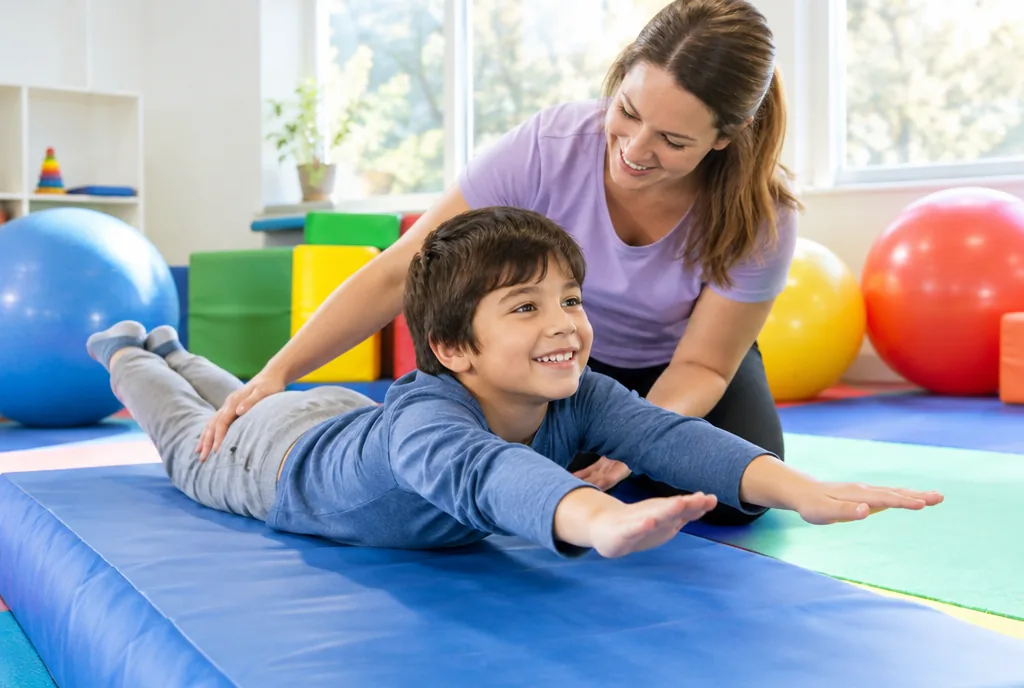
Spatial awareness is the ability to understand where your body is in relation to the room, other people, and objects around you. A child uses it to judge how far to reach for a cup, step around a chair, fit a puzzle piece into place, or catch a moving ball. It is not one isolated skill: body awareness, vision, balance, and visual-spatial thinking all contribute. The good news is that children can practice these skills through ordinary movement, building, games, and purposeful play.
Spatial awareness means knowing where things are and how they relate
A useful spatial awareness definition starts with relationships. Your child is noticing the position of their own body, estimating distance and size, and making sense of where objects are in relation to one another. Knowing that a cup is on the table rather than under it is a simple spatial relationship. Moving through a busy classroom without colliding with a desk is a more active one.
Spatial awareness also includes visual-spatial skills: the ability to take in a pattern, hold it in mind, and work with it. Those skills show up in three related ways. Spatial perception helps a child orient information to their own body. Mental rotation lets them imagine turning a two-dimensional or three-dimensional object. Spatial visualization supports multi-step processing, such as working out how several pieces could fit together.
Spatial orientation is closely related but deserves its own name. It is the ability to perceive where objects are relative to each other and to the viewer, especially when the perspective changes. A child may know where a block sits in a tower while facing it, then need spatial orientation to recognize the same arrangement from the other side.
Body awareness gives spatial skills a starting point
Before your child can reliably judge a doorway or a ball’s path, their brain needs information about their own body. That information comes from several sensory systems working together. Vision shows where objects are. Proprioception, sometimes called the internal sense of body position, continuously tracks limb position through specialized receptors in muscles, tendons, and joints. The vestibular system in the inner ear, made up of the utricle, saccule, and three semicircular canals, provides information about movement, balance, and spatial orientation.
Think about stepping over a toy while carrying a book. Your child must see the toy, sense where each foot is without looking down the whole time, and adjust balance during the step. That is why body awareness and spatial awareness overlap so often in everyday play.
| Skill or system | What it helps a child do | Everyday example |
|---|---|---|
| Vision | Locate objects and notice their size and distance | See an open space between chairs |
| Proprioception | Sense limb position and force | Reach for a cup without knocking it over |
| Vestibular input | Use movement, balance, and orientation information | Stay upright while turning to join a game |
| Visual-spatial thinking | Manipulate patterns, positions, and perspectives mentally | Turn a puzzle piece before placing it |
Notice patterns in daily life, not one awkward moment
Every child bumps into something, mixes up left and right, or misjudges a throw sometimes. A single rough game or backward letter does not define a child. What can be useful is noticing a repeated pattern across settings and tasks. Some children may have trouble locating something they see, hear, or feel, estimating distance, or maintaining their orientation in a space.
- They may bump into furniture or other people often, stand unusually close, or use much more or much less force than a task seems to need.
- They may find dressing hard, confuse left and right, or struggle to tell up from down in a practical situation.
- During writing, you may see inconsistent letter spacing, difficulty staying within margins, or poorly formed or mirrored letters.
- They may find ball games difficult because throwing and catching require ongoing judgments of distance, speed, and trajectory.
- On a playground or obstacle course, they may have trouble judging where their body can safely go.
These observations are not a diagnosis. Spatial difficulties can occur alongside many different developmental profiles, and the same behavior can have more than one explanation. Speak with a doctor if concerns are persistent, if your child has difficulty with balance, if skills are lost, or if movement creates a safety concern. Bring concrete examples: “They bump into the table several times at dinner” is more useful than a broad label.
Your child’s brain builds maps, positions, and routes
There is no single “spatial awareness button” in the brain. Spatial perception is mainly controlled by the right hemisphere, while several connected areas make different contributions. The parietal lobe processes spatial properties such as an object’s position, size, and orientation. That helps explain why spatial awareness is more than eyesight: the brain has to organize what the eyes and body report.
For navigation, place cells in the hippocampus fire when an organism is in a particular location, forming a cognitive map. Grid cells in the medial entorhinal cortex fire in a hexagonal grid and provide a neural basis for path integration and spatial navigation. Vestibular-thalamo-cortical connections carry information from the vestibular system through the thalamus to cortical areas, supporting spatial awareness such as sensing an upright body position.
You do not need to teach these brain terms to a child for them to benefit from play. They matter because they show why a rich mix of looking, moving, turning, balancing, and building gives spatial reasoning multiple kinds of practice.
Spatial awareness activities turn movement into useful practice
The most helpful spatial awareness activities give your child a clear relationship to notice: over or under, near or far, beside or behind, turn or stop. Keep the tone light. The goal is repeated experience, not a score or a test.
- Build a changeable obstacle course. Use safe household items to create places to crawl under, climb over, jump across, and balance along. Ask, “Is the next station in front of you or beside you?” Changing one element gives your child a new route to work out.
- Play Red Light, Green Light. Stopping, starting, and changing speed invite children to use their body in different ways. The game supports coordination and balance while giving directions meaning in motion.
- Trace a maze. A maze worksheet connects hand movements with visual cues and spatial relationships. Before tracing, have your child point to the start, the finish, and one turn they expect to make.
- Try children’s yoga poses. Yoga can support spatial awareness and balance as a sensory activity. Invite your child to notice a specific body part or the direction of a stretch rather than trying to make each pose look perfect.
- Make a Builder Copier challenge. One child builds a small model with blocks; another child copies it. Looking at the model from a different perspective encourages attention to object position and three-dimensional space.
Offer a small language cue while you play: “The blue block is behind the red block,” “Turn the piece,” or “How far do you need to jump?” These words connect action to a spatial relationship without turning play into a lesson.
A simple routine helps your child practice without pressure
Consistency matters more than making every session long. Children who played with puzzles, blocks, and board games more than six times a week had significantly higher Block Design scores than children who played occasionally, three to five times a week, or rarely. That finding is an association, not a rule that every family must copy. It does make a practical case for bringing varied spatial play into the week.
- Choose one focus. Pick one activity and one relationship, such as “over and under” in an obstacle course or “turn and fit” with a puzzle.
- Set up a clear space. Put out only the materials needed, and make movement areas safe before beginning.
- Model once. Show one action, then let your child try. For a maze, trace the first short section; for blocks, place one piece.
- Ask a noticing question. Try “Which piece needs to turn?” or “Where will your foot land?” A question gives your child a chance to plan rather than just follow.
- Change one variable next time. Reverse the route, view the model from another side, or add one block. Small changes invite fresh spatial reasoning.
Structured block play is particularly worth repeating. In one study, eight-year-olds who completed five 30-minute sessions of structured block play showed measurable changes in brain activation in regions associated with spatial working memory and improved speed and accuracy on mental rotation. That is a useful reminder that a familiar set of blocks can support more than one kind of learning.
Blocks, puzzles, and board games make positions visible
Building toys let children physically test an idea: Does this piece fit? What happens if it turns? Which block is higher, wider, or behind another? Puzzles add a visual-spatial challenge because a child has to compare shape, edge, orientation, and the larger picture. Neither activity needs a complicated setup to be meaningful.
Board games can add a different kind of practice. Connect Four and chess can improve a child’s understanding of spatial relationships, because players consider positions and possible moves on a shared board. A linear number board game such as Chutes and Ladders has documented benefits for preschoolers’ numerical knowledge, while other games may offer chances to talk about location and direction. Use the game for its actual rules and enjoyment; do not promise that every board game trains the same skill in the same way.
If siblings or friends play together, Builder Copier can be especially revealing in a positive way. The builder may say, “Put the long block across the top,” while the copier learns to check whether “top” means the same thing from their own viewpoint. Switch roles after each round so both children build, describe, look, and adjust.
Common myths can make spatial reasoning seem more fixed than it is
“A clumsy child simply is not paying attention.”
Frequent collisions or rough play can be worth noticing, but they are not proof of a character flaw or a diagnosis. Look for patterns, reduce avoidable hazards, and seek medical guidance when concerns persist or affect safety.
“Spatial awareness is just eyesight.”
Vision is important, but spatial awareness also draws on proprioception, vestibular information, and the brain’s ability to organize positions and movement. A child can see a chair clearly and still need practice judging how to move around it.
“Spatial skill is the same as IQ.”
No. Spatial ability is a distinct cognitive factor from verbal and mathematical reasoning, although some intelligence assessments include spatial tasks such as Block Design. Treating it as one part of a broader profile is more accurate than using it as a single measure of intelligence.
“You either have spatial skills or you do not.”
Spatial skills are trainable. A meta-analysis of 217 training studies found an average improvement of 0.47 standard deviations for spatial training compared with control conditions. The reported effects remained stable and transferred to tasks that were not directly trained, which supports giving children repeated, varied opportunities to practice.
Visual-spatial skills reach well beyond play
Spatial reasoning can support a child’s experience of maps, diagrams, building, movement, and problem-solving. Research also links it to longer-term learning outcomes without making it a prediction for any one child. Spatial ability measured at age 13 predicted creative and scientific achievement and patents more than 30 years later, beyond the predictive value of SAT math and verbal scores. It also predicted later STEM education and career paths when math and verbal abilities were considered.
In children ages 7 to 11, spatial skills including mental folding, spatial scaling, and disembedding explained 8% of the variation in science scores. Those findings are reasons to value opportunities to build, move, and imagine, not reasons to pressure a child toward a particular future. The immediate benefit is simpler: your child gets to practice making sense of the space they live and play in.
Frequently Asked Questions
What does it mean if a child lacks spatial awareness?
It can mean the child has difficulty judging positions, distances, directions, or how their body relates to objects and people. You might notice repeated bumping, confusion with left and right, trouble dressing, or uneven writing spacing. These signs are not a diagnosis; see a doctor when concerns are persistent, affect balance, involve lost skills, or create safety issues.
What is an example of spatial awareness?
Walking through a room without bumping into furniture is one example. Others include estimating how far to reach for an object, understanding that a cup is on rather than under a table, reading a map, turning a puzzle piece mentally, or tracking a ball’s path while catching it.
Is spatial awareness part of IQ?
Spatial ability is a separate cognitive factor from verbal and mathematical reasoning. Some intelligence tests assess it with tasks such as Block Design, but spatial awareness is not identical to IQ and should not be used as a label for a child’s overall intelligence.
How can you improve spatial awareness?
Offer frequent, varied practice through blocks, puzzles, mazes, obstacle courses, children’s yoga, Red Light, Green Light, and board games. Use simple location words during play, ask your child to predict a move, and change one part of an activity so they can plan again.
What part of the brain controls spatial awareness?
Spatial perception is mainly controlled by the right hemisphere, but several areas work together. The parietal lobe processes position, size, and orientation; the hippocampus and medial entorhinal cortex support maps and navigation; and vestibular-thalamo-cortical pathways contribute information about balance and orientation.