Vestibular input is the stream of movement and gravity information that helps your brain know whether your head is turning, tipping, rising, or moving forward. It is at work when a child leans back on a swing, looks down from a climbing structure, rolls across the floor, or steadies their eyes while walking. Because movement can feel organizing to one child and overwhelming to another, the useful question is not “Does this child need more movement?” but “What kind of movement helps this child participate comfortably?”
What vestibular input tells the brain
The vestibular system sits in the inner ear. Each ear has three semicircular canals and two otolith organs. The canals sit at roughly right angles to one another and register head rotation in three planes. The otolith organs register linear acceleration: the utricle responds to horizontal acceleration, while the saccule responds to vertical acceleration, including gravity.
In daily life, that information supports tasks that look simple from the outside. During head movement, the vestibulo-ocular reflex keeps the visual field stable, which is why letters can stay clear while you walk. When movement is unexpected, the vestibulospinal reflex adjusts postural and supporting muscles to help the body maintain balance.
| Part of the system | What it detects or supports | Everyday example |
|---|---|---|
| Semicircular canals | Rotational movement | Turning in a circle or spinning |
| Utricle | Horizontal linear acceleration | Moving forward on a swing |
| Saccule | Vertical acceleration and gravity | Going up, down, or changing head position |
| Vestibulo-ocular reflex | Stable vision during head movement | Looking at words while walking |
| Vestibulospinal reflex | Posture and balance responses | Staying upright after an unexpected shift |
Vestibular receptors are activated whenever the head moves in relation to gravity: a tilt, a turn, a jump, or an inversion all supply input. Even so, balance is not a vestibular job alone. It also depends on proprioception from muscles and joints and on vision. For that reason, a child can look unsteady for more than one reason.
When a child seeks or avoids movement
In practice, seeking vestibular input usually describes a child who appears to need stronger or more frequent movement in order to feel regulated or alert. With vestibular hyposensitivity, movement and balance changes may be felt less intensely. A child may spin, bounce, climb, swing hard, run impulsively in open spaces, or seem unusually unfazed by dizziness. These observations are clues about sensory responses, not a diagnosis.
For other children, vestibular hypersensitivity makes movement feel too intense. A child may fear swings, slides, roller coasters, or heights; become dizzy or nauseated quickly; or avoid the playground altogether. On uneven surfaces, some children who avoid vestibular input show less secure balance and closely watch spinning objects such as ceiling fans.
Watch the pattern, not one behavior
A single enthusiastic day on the merry-go-round does not establish a sensory pattern. Instead, look for what happens repeatedly and in context. For example, a child who seeks the fastest swing before a seated task may be looking for an alerting transition. A child who stiffens, asks to stop, or turns pale on a slow swing is telling you that the activity is not comfortable right now. Their response matters more than a label.
- Possible seeking signs: constant jumping, rocking, spinning, climbing, frequent movement, or little apparent dizziness.
- Possible avoiding signs: reluctance with slides or swings, fear of heights, quick dizziness or nausea, and avoidance of playground movement.
- Useful next step: offer a safe choice, start briefly, and notice what changes during and after the activity.
Vestibular activities for kids: match movement to the moment
Vestibular activities do not all feel alike. Five broad movement types—linear, orbital, rotational, inversion, and side-lying—give the nervous system different information about the body in relation to gravity. Rather than relying on one favorite activity, a balanced sensory routine can draw from all five.
| Movement type | What it looks like | Activity ideas |
|---|---|---|
| Linear | Back-and-forth or up-and-down movement | Slow swing movement, rocking, gentle ball play |
| Orbital | Movement along a curved path | Circling movement in an obstacle course |
| Rotational | Turning around an axis | A seat spinner or a spinning swing |
| Inversion | Head lower than the body | Somersaults or an inversion on a platform swing |
| Side-lying | Moving or resting on either side | Side-lying play or rolling activities |
Slow, rhythmic, linear movement such as gentle back-and-forth swinging can be calming. By contrast, faster, jerky, or rotational movement can be alerting. That difference helps explain why a quiet swing may fit one moment while a fast spin may not. Still, neither response is universal: observe the child rather than assuming an activity will have the same effect every time.
Build a movement menu from ordinary play
- Try a swing, trampoline, balance beam, scooter board, yoga, or an obstacle course.
- Use animal walks, dancing, bicycle riding, skating, or playground equipment that includes swinging or spinning.
- Combine movement with a goal: cross a balance beam to reach a puzzle piece, then return another way.
- Before a fine-motor task, a child who seeks movement may benefit from a short movement break such as five minutes on a trampoline.
Active participation changes the experience. A child who propels a swing or moves through a course adds proprioceptive input to the movement experience; that is different from being passively moved. When possible, let the child help control the pace and choose the next activity.
Make swinging and spinning safer and more useful
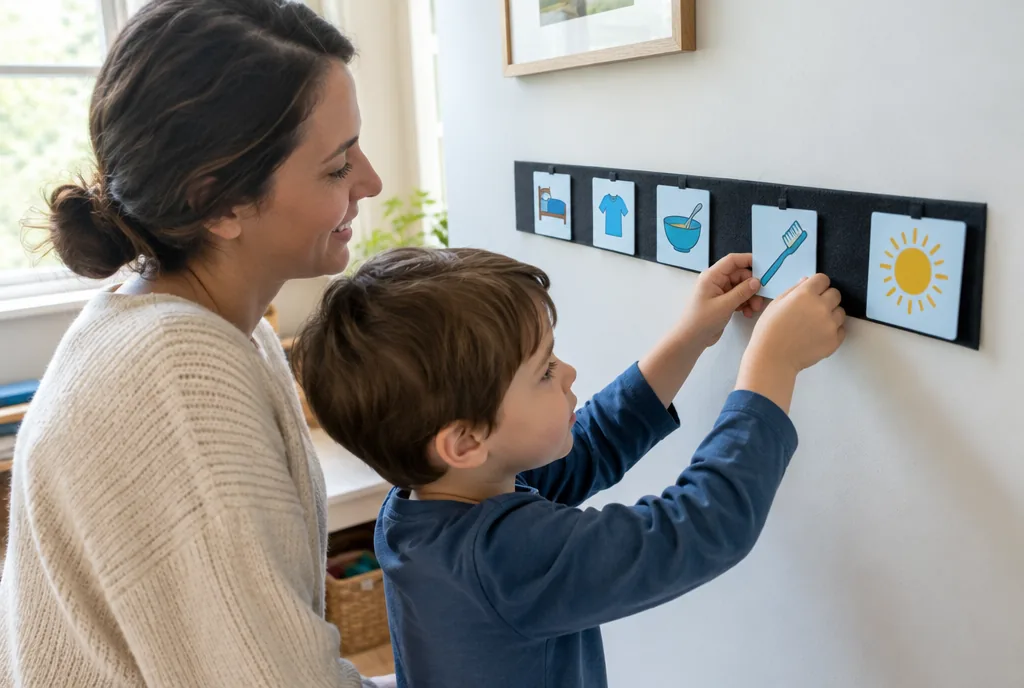
Begin with predictability. Before the activity, tell the child what will happen or show it visually, then offer a short experience and watch the response during and afterward. If they resist, look distressed, become nauseated, or lose their balance, stop. Never force an activity.
- Choose one movement and describe it before it begins.
- Keep the first turn brief and let the child decide whether to continue.
- Pause and observe posture, facial expression, balance, and comfort.
- Adjust the speed, direction, or activity—or stop—based on what you see.
Take special care with rotation. Spinning in one direction should last no more than 10 to 15 seconds before a pause or a change of direction. Longer rotation can trigger nystagmus, sensory overload, and disorganization. The central safety rule is control: the child should be able to decide when to stop. When spinning is forced, it can create nausea, fear, and stronger avoidance of vestibular experiences.
Swing types differ. On a platform swing, a child can experience linear movement while sitting, standing, lying down, or balancing; it can also be used for rotation and inversion. Compared with playground swings, therapy swings offer features such as adjustable suspension, a lower seat position, and positions including prone or side-lying. Not every child needs specialized equipment, but it helps to understand why an occupational therapist may choose it for a particular goal.
Vestibular input for babies begins in everyday care
From the fourth to fifth week of pregnancy, the vestibular system begins developing from the ear placode. By birth, an infant responds to changes in position; these responses underlie reflexes including the Moro reflex and the asymmetric tonic neck reflex. Gentle movement is a normal part of early care, not a special therapy routine.
For babies, vestibular input can come from rocking in your arms, gentle rocking while securely supported on an exercise ball, or carrying your baby in different positions. Throughout these routines, keep movement gentle and responsive. A baby’s comfort cues should guide the pace and duration.
Over time, your baby develops head control, independent sitting, and crawling. Delays in these areas can occur with vestibular processing concerns, but they do not identify the cause on their own. If you are concerned about persistent delays in head control, sitting, crawling, movement, or balance, bring those observations to a pediatrician or another qualified clinician rather than trying to solve them with more movement at home.
What movement can and cannot tell you about ADHD or autism
Because movement seeking can resemble restlessness, fidgeting, or inattention, it may be confused with ADHD. By itself, it is not enough to diagnose ADHD. In a 2024 study, researchers found vestibular hypofunction in a subgroup of children with ADHD, particularly those who also had developmental coordination disorder (DCD). At the same time, a 2023 study of stochastic vestibular stimulation found no significant improvement in cognitive performance or reaction-time variability compared with sham stimulation. For some children, vestibular differences may matter, but they do not explain ADHD as a whole.
In autism, vestibular symptoms are often understood as part of multisensory conflict or integration differences rather than an isolated vestibular dysfunction. For self-regulation, some autistic children seek movement through actions such as spinning or rocking. That pattern can help you plan supportive, child-led activity; it is not a diagnostic test. In a 2025 study, vestibular and proprioceptive exercise was associated with reductions in hyperactivity and impulsivity in children with autism, but individual needs still require individual assessment.
Three myths that can make movement harder
Myth: More spinning is always better for a movement seeker
More spinning is not automatically more helpful. Fast rotation can be alerting, and extended rotation can overwhelm the system. Instead, use brief, controlled opportunities, include pauses, and follow the child’s response.
Myth: Sensory seeking means ADHD
A child can seek movement for many reasons. It may overlap with attention or coordination concerns, but movement seeking alone cannot identify ADHD or another condition.
Myth: A swing works the same way for every child
Speed, direction, position, choice, and the child’s current state all change the experience. For one child, slow linear swinging may be calming; another may prefer active climbing or may need less movement altogether.
When occupational therapy or medical care is the next step
When movement, balance, dizziness, spatial orientation, or sensory responses interfere with daily activities, consider professional guidance. Occupational therapists can evaluate balance, dizziness, spatial orientation, and functional limitations. Depending on the goal, intervention may involve platform swings, scooter boards, therapy spinners, wobble cushions, balance boards, therapy balls, or climbing equipment.
For dizziness, nausea, balance problems, or developmental concerns, contact a doctor. For sudden or severe symptoms, seek immediate medical care. Watching patterns can help you choose safer everyday activities, but it cannot diagnose a vestibular condition or replace an evaluation.
Frequently Asked Questions
What is vestibular input?
Vestibular input is sensory information from the inner ear about head position, movement, acceleration, and gravity. It contributes to stable vision, posture, and balance.
What does seeking vestibular input mean?
It means a child frequently looks for movement such as jumping, spinning, swinging, rocking, or climbing. Vestibular hyposensitivity can make changes in movement and balance feel less intense.
What is an example of a vestibular sensory issue?
A child who avoids slides and swings because movement quickly causes dizziness or nausea is one example. A child who continually spins and seems not to get dizzy is a different pattern that may reflect movement seeking.
How does vestibular input affect ADHD?
Some children with ADHD, especially those with DCD, may have vestibular hypofunction, but movement behaviors do not diagnose ADHD. Research findings on vestibular stimulation are mixed, so assessment should consider the whole child.
What is vestibular input for babies?
For babies, it is the information provided by changes in position and gentle movement, including rocking, supported movement on an exercise ball, and being carried in different positions. Follow comfort cues and discuss developmental concerns with a clinician.