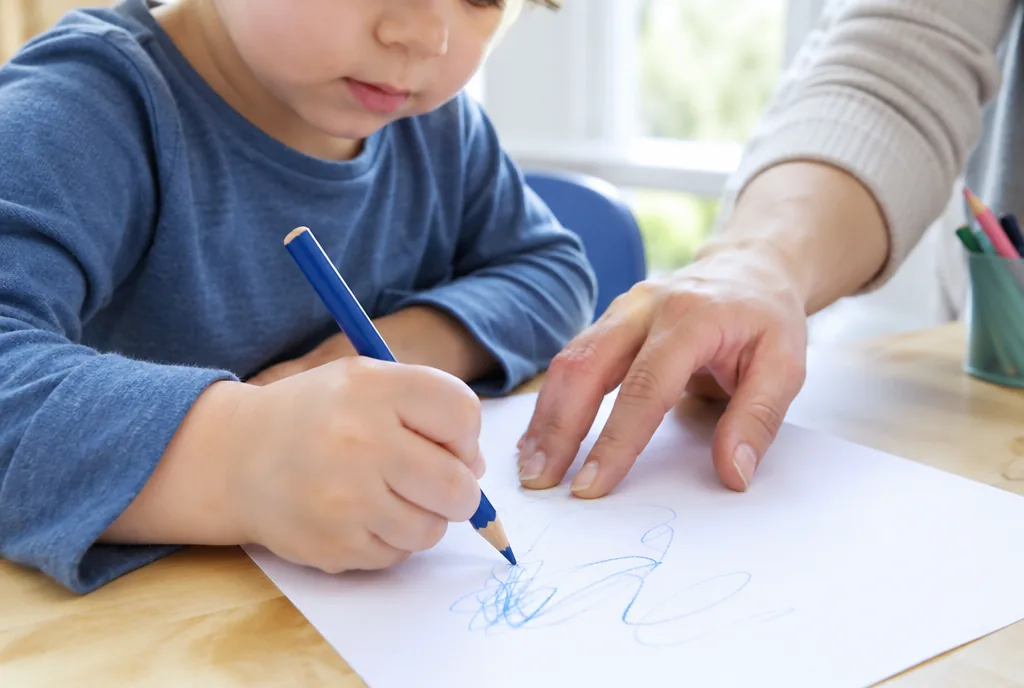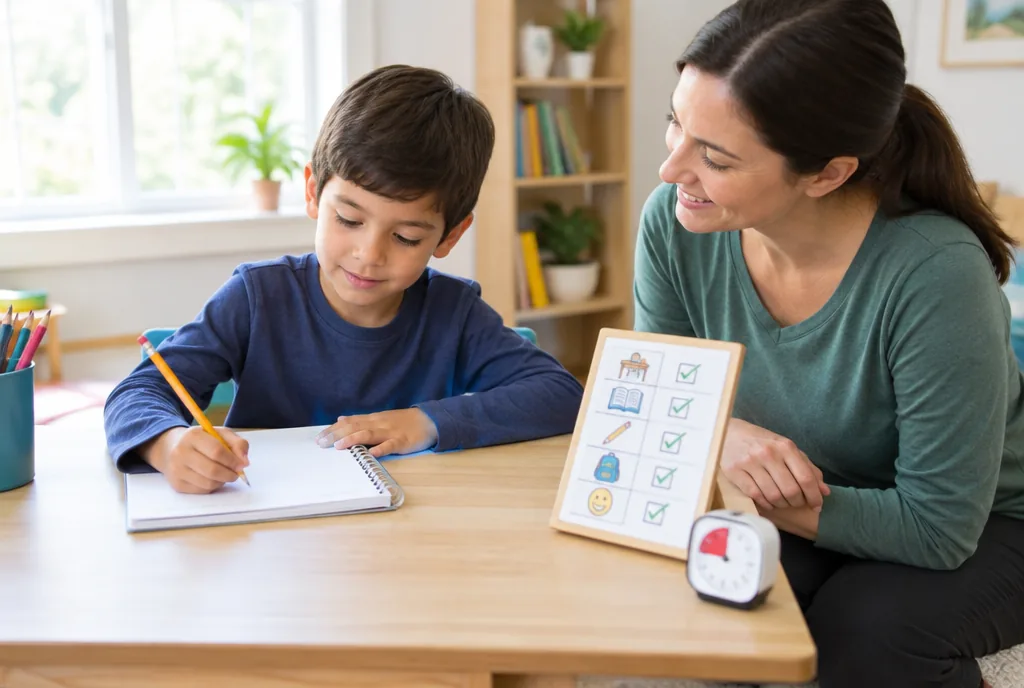
Visual motor integration is the ability to coordinate what the eyes see with what the hands and body do. In practice, it lets a child look at a letter, a button, a moving ball, or a line on a page and organize a movement in response. That link goes far beyond handwriting. It supports eating with utensils, tying shoelaces, threading a bead, copying a shape, and joining a ball game. Children build this skill over time, starting with early experiences such as visually tracking an object and batting at a dangling toy.
What visual motor integration looks like in everyday life
Visual motor integration, often shortened to VMI, brings together three jobs. First, the brain processes visual input. Next, the child interprets what is seen. Finally, the body moves in response. VMI was described by Keith Beery as the degree to which visual perception and finger-hand movements are well coordinated.
Picture a child copying a simple shape. The eyes notice the lines, direction, and size of the model. The brain uses those details to plan where to begin. The hand then controls the pencil through each stroke. A similar sequence happens when a child guides a fork to food or reaches for a ball.
- At school: forming letters, leaving space between words, and copying from a board all use VMI.
- During self-care: buttons, zippers, snaps, shoelaces, and utensils call for vision to guide small hand movements.
- In play: building with blocks, fitting puzzle pieces, threading beads, and ball games connect seeing with doing.
Visual perceptual skills are important here, but they are only part of the picture. A child may recognize a shape yet have trouble organizing the hand movement to reproduce it. On the other hand, a willing hand cannot copy a shape accurately if the visual details are not clear to the child. VMI is what connects both sides of the task.
Signs that may make visual motor integration worth a closer look
One difficult worksheet or one missed catch does not tell you why a child is struggling. Still, a consistent pattern across writing, play, and self-care can be useful to notice. Some children with weaker VMI color outside the lines, struggle to copy geometric shapes or material from the board, or find buttons and shoelaces unusually difficult.
- Handwriting may be large, poorly coordinated, or spaced inconsistently.
- A child may hold a pencil awkwardly, press too hard or too lightly, or take much longer than classmates to finish writing.
- They may change their starting position on the page, reverse letters, or find copying more difficult than tracing.
- Throwing, catching, or kicking a ball can be hard, and learning movements such as hopping or riding a bike may take longer.
- Frequent tripping or falling may appear alongside difficulty learning new movements.
A revealing comparison is tracing versus copying. When tracing, the line supplies the route, so the child does not need to decide the starting point, length, or direction of every stroke. In free copying, those decisions are required. A child can therefore trace a shape well and still struggle to copy the same shape beside it.
These signs are not a diagnosis. If they persist, interfere with schoolwork or daily tasks, or worry you, discuss them with a pediatrician or a qualified professional such as an occupational therapist.
Why handwriting and shape copying can feel so demanding
VMI is a significant predictor of handwriting performance, especially in the first school years, because younger students rely more on visual feedback. Still, it does not explain every handwriting challenge. Eye control, pencil control, attention, and planning matter too. For that reason, messy writing alone does not prove a VMI difficulty.
Copying shapes offers a practical window into the same process. The general milestones below show increasing complexity children may manage; they are reference points, not deadlines for judging an individual child.
| General age | Shape a child may copy or imitate |
|---|---|
| 2 years | Vertical line |
| 2½ years | Horizontal line |
| 3 years | Circle |
| 3½ years | Cross (+) |
| 4 years | Square and X |
| 4½–5 years | Triangle |
| 5 years | Diagonal lines and an open box |
Take a classroom example: copying a word from a board requires a child to look up, take in the letter sequence, look back down, and guide the pencil across the page. In near copying, the model sits close by; far copying adds the shift between a distant model and the paper. Both tasks are useful, but they place different demands on the child.
Visual motor integration activities that turn practice into play
The best activities give the eyes a clear job and the hands a meaningful response. Instead of repeating one page until it becomes frustrating, rotate a few options. Start at a level where your child can succeed, then add one small challenge.
- Paper mazes: Following a route asks the eyes to guide the pencil without crossing a boundary. Paper mazes add starting, stopping, changing direction, and using appropriate pencil pressure.
- Dot-to-dot and rainbow ladders: These activities give practice moving from point to point, following a sequence, and changing direction.
- Near and far copying: Invite your child to copy a simple line, shape, or design from a nearby card, then from a more distant model.
- Raised glue letters: Let glue letters dry, then have your child feel the path with a finger before attempting it with a pencil.
- Beads, puzzles, and blocks: Threading, fitting, stacking, and matching all require precise placement guided by sight.
- Origami or paper airplanes: Folding asks a child to line up edges, attend to creases, and use both hands in a planned sequence.
- Ball games: Use predictable tosses at a comfortable distance. Catching requires timing and eye-hand coordination, while throwing lets a child match a movement to a visual target.
Mazes are particularly rich because they combine eye-hand coordination with figure-ground perception, visual discrimination, position in space, visual memory, visual closure, and form constancy. In a physical toy maze, the focus is moving through space; on paper, the maze adds pencil control and boundary-following.
Make activities easier first, then more independent
Tracing is a useful starting point, but not the final goal. It gives a child a visual route to follow. Once a basic shape feels secure, offer a nearby model to copy, then move toward real letters. After basic shapes are established, practicing actual letters puts the skill into the task children use most at school.
You can also try a vertical surface such as a whiteboard, easel, or wall-mounted paper. Working upright reduces the demand on finger fine-motor control and leaves more attention for planning and comparing a shape. That setup can make a new copying task more approachable without changing what the child is learning.
In occupational therapy, structured throwing and catching may support VMI, visual-spatial learning, and social skills. For children with learning difficulties, targeted activities such as dot-to-dot, near copying, and far copying have also been found effective for copying from the board. If home practice is not enough for a persistent functional concern, an occupational therapist can help identify which part of the task needs support.
How the Beery VMI test examines copying skills
Keith Beery and Norman Buktenica developed the Beery-Buktenica Developmental Test of Visual-Motor Integration in 1967. It is commonly called the Beery VMI, and the sixth edition dates from 2010. The long form has 30 shape-copying tasks that grow more complex and is normed for ages 2 through 100.
The short form has 21 tasks for ages 2 through 7 and serves as a screening tool that takes about 10 minutes. A full Beery VMI administration takes about 10 to 15 minutes on average. Two optional 30-item subtests can add useful detail: visual perception asks the child to identify a matching shape from choices, while motor coordination asks the child to trace forms within boundaries.
When the core score raises questions, those subtests can help distinguish whether the challenge appears visual-perceptual, motor, or combined. Keep in mind that the test measures copying geometric forms, not real handwriting or catching a ball. A professional should interpret any result alongside the child’s everyday tasks and your concerns.
Common myths that can get in the way of useful support
Tracing and copying are the same skill
The two overlap, but tracing supplies the path. Copying requires the child to choose a starting point and reproduce length and direction independently. Success with one does not guarantee success with the other.
Messy handwriting always means poor VMI
VMI is linked to handwriting, particularly in younger students, but the relationship is moderate rather than perfect. Eye control, pencil control, attention, and planning also shape the finished page.
A single score tells the whole story
The Beery VMI can add clarity about copying skills, but it does not test every real-world task. It cannot stand in for observing a child write, play ball, fasten clothing, or manage other daily activities.
Improvement only comes from worksheets
Besides mazes and copying, bead threading, puzzles, blocks, folding paper, and structured ball games can help. What they share is a specific link between visual information and a purposeful movement.
Frequently Asked Questions
What is visual motor integration?
Visual motor integration is the coordination of visual perception with hand and body movement. It supports tasks such as handwriting, copying shapes, using utensils, fastening clothing, and ball games.
What does poor visual motor integration look like?
Possible signs include trouble copying shapes or board work, inconsistent handwriting, difficulty staying within lines, and challenges with buttons, shoelaces, or ball skills. These signs alone do not diagnose a condition.
How can you improve visual motor integration?
Use activities that connect seeing and doing: mazes, dot-to-dot, copying, beads, puzzles, blocks, paper folding, and predictable throw-and-catch games. Begin with an achievable level and move from tracing toward copying and letter formation.
What are visual motor integration activities?
Paper mazes, raised-letter tracing, rainbow ladders, dot-to-dot pages, near and far copying, coloring, bead threading, puzzles, building blocks, and ball games are all examples.
How is visual motor integration tested?
The Beery VMI uses increasingly complex copied geometric forms and may include visual-perception and motor-coordination subtests. Test results are not a diagnosis; see a pediatrician or qualified professional when concerns persist or affect daily life.