A sensory seeker is a child who actively looks for strong sensory input—movement, pressure, sound, touch, or oral input—often by jumping, crashing, spinning, climbing, chewing, or squeezing into tight spaces. From across the room, sensory seeking behavior can look chaotic, but it is often a purposeful attempt to get a particular feeling in the body. Rather than asking “How do I make this stop?”, ask “What input is this child seeking, and how can I offer it safely before it creates a problem?”
What sensory seeking behavior can look like
In daily life, a sensory seeker may be in constant motion, crave roughhousing, use too much force with other children, or touch everything within reach. Other common signs include chewing on sleeves, collars, pencils, or fingers; climbing; jumping; spinning; pressing into sofa cushions; and crawling under furniture or blankets. A child who repeatedly squeezes into narrow spaces or asks for firm hugs may be seeking pressure and proprioceptive input—the information muscles and joints provide about body position and effort.
In Dunn’s model, sensory seeking is one of four sensory-processing patterns, alongside avoiding, sensitivity, and low registration. This is a pattern, not a diagnosis. Everyone shows some of each pattern, and the balance can change with the setting, the sense involved, and the demands of the moment. The popular idea that seekers simply register too little input is also in doubt: a correlation study of 787 typically developing adolescents and adults found virtually no relationship between sensory seeking and low registration.
It also helps to separate sensory seeking from sensation seeking. Sensory seeking describes a need for specific body-based input that shows up from early childhood. By contrast, sensation seeking is a personality trait associated with novelty and risk-taking that rises between ages 10 and 15. When your child wants to jump into a pile of cushions, they are not necessarily looking for risk; they may be looking for movement and deep pressure.
Sensory seeking vs. sensory avoiding: both can fit the same child
Although seeking and avoiding are often presented as opposites, they can show up in the same child on the same day. Your child may crash into furniture all afternoon and still refuse hair washing. That is not a contradiction. Crashing gives a child wanted movement and pressure, while water, sound, touch, or smell during hair washing can feel like too much.
| Pattern | What you might notice | A practical response |
|---|---|---|
| Sensory seeking | Crashing, climbing, spinning, chewing, constant touching | Offer a safe, planned outlet for the specific input. |
| Sensory avoiding | Covering ears, refusing textures, leaving loud spaces | Reduce or modify the input rather than pushing through it. |
| Both patterns | Jumping eagerly but resisting hair washing | Look at the sense and situation, not one label. |
Cleveland Clinic distinguishes over-responsivity, under-responsivity, and sensory craving. In avoidance, a child may react strongly and retreat from input. In seeking, they approach it. With sensory craving, someone keeps seeking input but does not seem satisfied by it. That distinction matters because more stimulation does not automatically calm every child. Watch your child’s response rather than assuming that a favorite activity will work the same way every time.
Does sensory seeking behavior mean ADHD or autism?
No. Although the two can occur together, sensory seeking is not the same as ADHD. On average, people with ADHD have higher scores than control groups across all four Dunn patterns: seeking, avoiding, sensitivity, and low registration. For a sensory seeker, the sensory experience itself—such as pressure, chewing, or movement—is the goal. In contrast, a child who appears hyperactive may be having trouble holding movement back. Because the two patterns can overlap, one observation cannot sort them out.
On its own, sensory seeking is not a sign that a child is autistic. Although unusual sensory interests are one of four restricted or repetitive behavior features in the DSM-5, an autism diagnosis also requires differences across all three social-communication areas. In a meta-analysis of 14 studies, sensation seeking showed the smallest difference between autistic and typically developing groups, after under-responsivity and over-responsivity. Sensory seeking also occurs in typically developing children. In one study of 239 children ages 3 to 14, seeking scores decreased with age regardless of whether children were autistic, had ADHD, or were typically developing.
Use observations to start a conversation, not to diagnose. Jot down what happens before the behavior, what the child does, what input they get, and what changes afterward. For example, a child who chews a shirt during quiet work and accepts a safe chew tool may be seeking oral input at that time. A child who crashes after an hour of sitting may need a planned movement-and-pressure break before the next long seated task.
Give sensory seekers safe outlets before the hard moment
Often, timing is more useful than correction. Instead of waiting for the child to leap from the sofa or barrel into a sibling, put an allowed activity before the predictable hard moment: movement before homework, heavy work before dinner, or playground time before a car ride. Recess should not be taken away as punishment; for a child who needs movement to regulate, it can be an essential resource.
At home or school, create one clear place where crashing and jumping are allowed. A crash pad can be a soft floor mat, mattress, beanbag, or pile of cushions used as the target—not the sofa and not another person. Crashing and jumping combine proprioceptive input with vestibular input, which comes from the inner-ear system that reports head movement, direction, and speed. For a simple boundary, say: “Feet land on the crash pad.”
When the child directs it, deep pressure can be another safe outlet. Options include a requested bear hug, rolling in and out of a blanket, or lying under cushions with light pressure. Do not restrain a child. In a 2025 review, deep pressure paired with caregiver training in sensory strategies had strong evidence, but a child’s comfort and ability to opt in still matter.
Activities that bring movement and pressure with a clear purpose
Heavy work means pushing, pulling, lifting, carrying, climbing, or squeezing against resistance. It delivers proprioceptive input and can be built into ordinary routines. For school-age children, climbing, running, and jumping can also contribute to the CDC recommendation of at least 60 minutes of daily physical activity, including muscle- and bone-strengthening activity.
- Do two minutes of wall push-ups. Before a seated classroom task, this is a quick, low-key option.
- Carry or move something useful. Have your child carry groceries, books, or a filled backpack; at school, jobs can include delivering materials, wiping the board, or stacking chairs.
- Pull and push. Try tug-of-war, animal walks, pushing a laundry basket, or moving a stroller.
- Make a crash-pad routine. Choose a set number of jumps or safe landings, then move on to a quieter task.
- Use movement thoughtfully. A dance party with head turns, a log roll on the floor, a blanket swing, or gentle rocking on an exercise ball all provide vestibular input.
Depending on duration, direction, and intensity, vestibular input can be alerting or calming. Rhythmic, linear movement tends to calm more than fast spinning. After swinging, rocking, rolling, or spinning, follow with heavy work or deep pressure rather than adding more movement. That sequence gives your child a concrete way to transition from motion to the next activity.
Chewing and toys for sensory seekers need safety rules
Oral sensory seeking can look like chewing sleeves, collars, pencils, fingers, or nails. Between ages 3 and 6, nail biting and chewing on pencils or fingers can begin as common self-soothing habits, and punishment tends to make such habits worse rather than stop them. Instead of treating the behavior as defiance, offer a safer alternative matched to the need.
Depending on the child, an occupational therapist may recommend gum for age 4 or older, a designated chew tool, chewy foods such as bagels or jerky, or crunchy foods such as carrots, apples, pretzels, or rice cakes. A chew tool is often a better option than clothing or pencils. For safety, never leave a child unsupervised with chewing jewelry or use a corded item: the FDA warns that teething jewelry can create strangulation and death risks when used at night or without supervision.
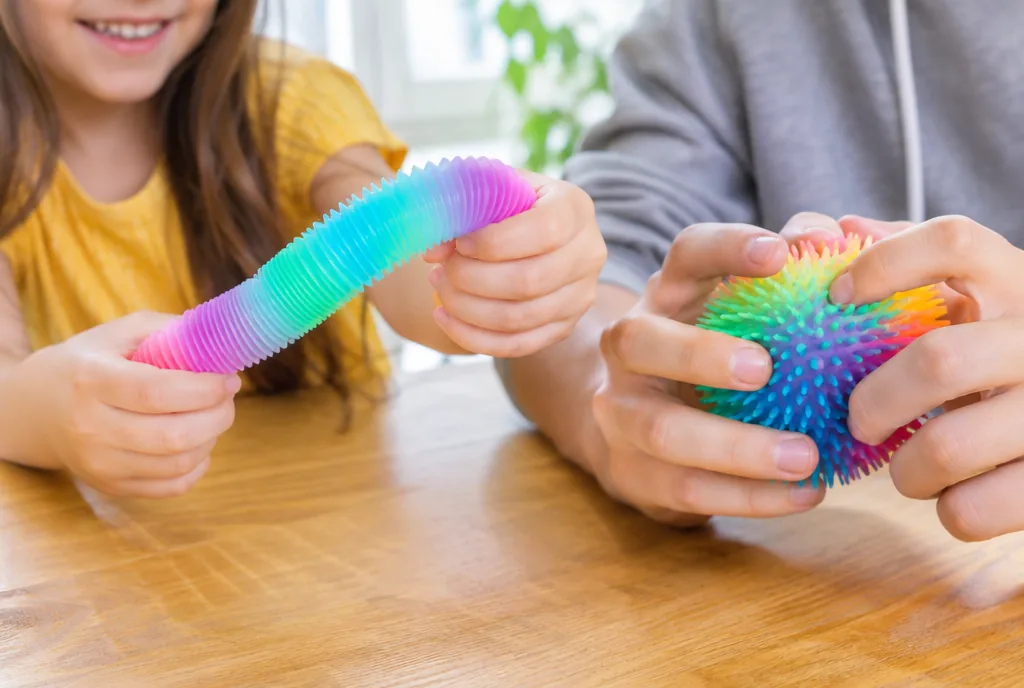
For a child who repeatedly seeks input, toys can provide a safer route. Options include a trampoline, climbing structure, balance board, crash pad, therapy ball, resistance bands, swings, rocking toys, therapy putty, stress balls, textured mats, or sand and water play. When choosing, match the toy to the child’s pattern, supervise active equipment, and treat it as an activity tool—not a promise that it will fix attention or behavior.
Use a sensory diet as a personalized plan, not a random menu
A sensory diet spreads individualized sensory activities across the day to help your child stay in a just-right alert state. It is developed with an occupational therapist, not copied from a list. Because a useful plan needs a baseline, the American Occupational Therapy Association advises against sensory interventions without documented assessment, such as the Sensory Profile 2.
- Find the repeatable moment. In a quick note, record when the behavior happens, what came before it, and what follows.
- Match the input to the pattern. If your child crashes at noon after an hour of sitting, schedule heavy work before it, for example at 11:45.
- Keep the activity observable. A two-minute wall-push-up break or a book-carrying job is easier to repeat and evaluate than a vague instruction to “get energy out.”
- Review the response. If your child becomes more dysregulated, stop assuming more input is better and discuss the pattern with the OT.
In the United States, a free occupational therapy evaluation may be available through state Early Intervention before age 3 and through a local public elementary school from age 3, without a doctor’s prescription. With a structured assessment, an OT can help you understand what a repetitive behavior does for your child before anyone tries to reduce it.
Common myths can lead to the wrong support
Myth: A child who seeks input just needs more stimulation
Not always. Sensory cravers may keep seeking input even when it leaves them dysregulated. Choose a specific, safe activity, watch the result, and use professional guidance for an individualized plan.
Myth: Any fidget or alternative seat improves attention
That shortcut is not supported by evidence. Across three studies, alternative seating such as wobble cushions or ball chairs showed no significant attention improvement; a 2025 review described them as tolerance tools rather than treatments. In a study of 60 children with ADHD, fidget spinners worsened attention during use. A quiet stress ball or putty may be a better classroom option than a spinner, but judge it by your child’s response.
Myth: A weighted blanket is automatically a calming answer
For infants, weighted blankets are unsafe because they can interfere with breathing. In one study, autistic children liked them but did not sleep better; in a study of children with ADHD, sleep duration increased by an average of eight minutes. Before using one with an older child, talk with the appropriate clinician rather than treating a blanket as a universal solution.
Frequently Asked Questions
What is a sensory seeker?
A sensory seeker actively pursues strong input through movement, pressure, chewing, touch, or sound. This behavior is a sensory-processing pattern, not a diagnosis.
Does sensory seeking mean ADHD?
No. Sensory seeking occurs in typically developing children as well as in children with ADHD, so it cannot identify ADHD on its own. Sensory strategies can be part of a broader plan, but they do not replace ADHD treatment.
Is a sensory-seeking child autistic?
Not necessarily. Sensory seeking by itself does not establish autism. An autism assessment also looks at social communication and other features, so discuss broader, persistent concerns with a qualified clinician.
How do you calm a sensory seeker?
Before a difficult moment, offer the needed input on purpose: a planned heavy-work job, an allowed crash-pad routine, or child-directed deep pressure. Then watch whether the activity helps; more stimulation is not always more calming.
What activities help sensory seekers?
Heavy work such as pushing, pulling, carrying, climbing, and squeezing gives your child proprioceptive input. After movement activities such as swinging, rolling, or rocking, add heavy work or deep pressure.
When should I see a doctor?
Seek medical advice if your child bangs their head frequently, eats nonfood items after age 2, shows no awareness of danger at age 4, suddenly loses skills, or injures themselves or others. These signs need medical attention, not only sensory strategies.