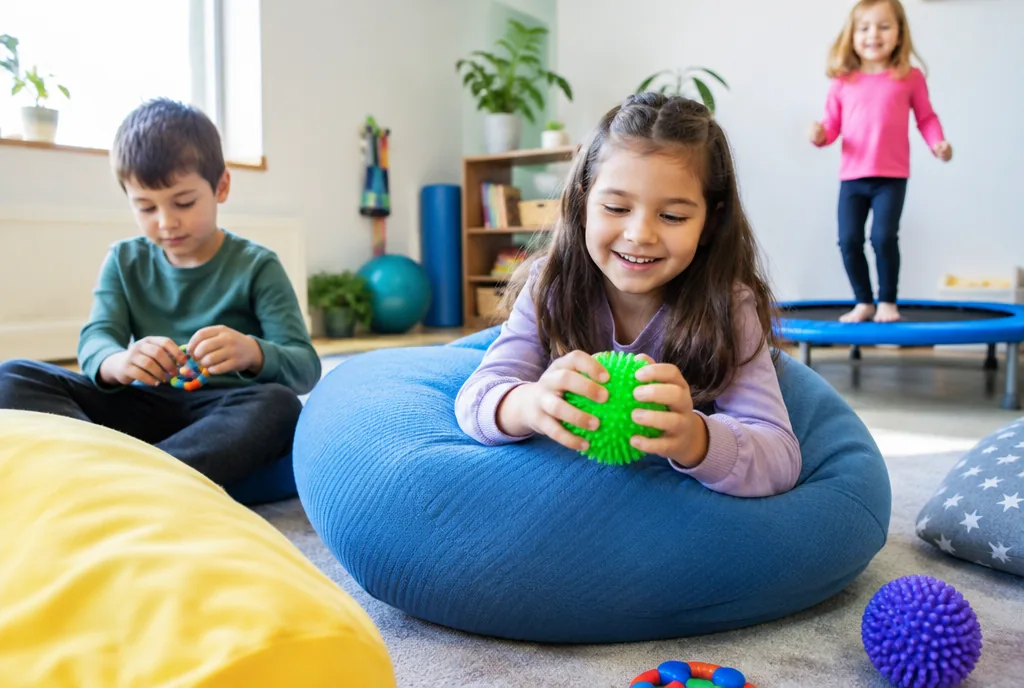
Proprioceptive input is the body information that tells your child where their body is, how it is moving, and how much force it is using. It comes from work in the muscles, tendons, and joints, so pushing against a wall, doing a bear crawl, or kneading dough all give a child useful feedback. When that feedback is hard to register, a child may seek it in big, messy-looking ways. A short, purposeful activity before the next hard moment often helps.
What Proprioceptive Input Tells Your Child’s Body
Proprioception, sometimes called kinesthesia, works mostly below conscious awareness. It lets you touch your nose with your eyes closed, walk without watching your feet, or pick up an egg more gently than a pencil. Receptors in the muscles, tendons, joints, and the balance organs of the inner ear send sensory information about body position, movement, force, and pressure.
That is why proprioceptive input is not one special exercise. Pushing, pulling, lifting, carrying, jumping, chewing, and deep pressure all feed the proprioceptive system. In occupational therapy, activities that load the muscles and joints are called heavy work. A child pushing a book-filled laundry basket across the floor is doing heavy work, and so is a child hanging from playground bars.
When you plan activities, keep this separate from vestibular input. On a swing, the movement and balance information goes mainly to the vestibular system. Pumping the legs, holding the ropes, or pushing off the ground adds proprioceptive input. The two sensory systems answer different questions: “Am I moving?” versus “Where is my body, and how hard is it working?”
Notice the Patterns That Can Signal a Need for More Feedback
One behavior on its own does not point to a sensory processing problem. Look for a pattern that repeats, especially around transitions, seated work, or busy days. Some children seek stronger body feedback; others find it hard to judge force, position, or movement.
- Chewing sleeves or pencils, or biting other objects
- Pressing so hard when writing that pencil points break
- Gripping objects with too much force or hyperextending joints
- Crashing heavily to the floor; running, jumping, or stomping instead of walking
- Bumping into furniture or people, tripping often, or seeming generally clumsy
- Slumping in a chair or leaning hard on furniture
- Toe walking, which can have more than one cause
A child who bears down hard on a pencil, for example, may be trying to get more feedback from the hand rather than being careless with supplies. A more useful question than “How do I stop this?” is “What safe, acceptable activity could meet the same sensory need?”
Use These Heavy Work Activities at Home and School
Choose activities that fit the setting and your child’s abilities. Short, frequent bursts often work better than one long session, and some take only 30 seconds. Offer heavy work before a challenging transition instead of waiting until your child is already overwhelmed.
| Setting | Proprioceptive activity | What the body works against |
|---|---|---|
| Home | Push a laundry basket or box filled with books across the floor | Whole-body pushing resistance |
| Kitchen | Knead dough or press and squeeze modeling dough | Hand and finger resistance |
| Outdoors | Carry a watering can, rake, dig, or shovel in the garden | Carrying and pushing through the arms |
| Playground | Climb, hang from bars, or use a trapeze | Body weight through the arms and shoulders |
| Classroom | Do chair push-ups or press feet into a chair band | Muscle resistance while staying at the desk |
| School routine | Wipe tables, stack chairs, carry books, empty a bin, or use a manual pencil sharpener | Useful pushing, lifting, and turning |
Other physical activities include wheelbarrow walks, where an adult holds the child’s legs while the child walks on their hands, and animal walks such as bear walks, crab walks, or seal crawls. At home, a pillow sandwich (gentle pressure between two cushions) or rolling up snugly in a yoga mat adds deep pressure. For oral proprioceptive input, try chewing gum, crunchy snacks, or chew jewelry. Match each activity to your child and supervise as needed.
Build a Calming Routine Before Focus Is Needed
Proprioceptive input tends to organize and calm the nervous system. Vestibular movement can calm or alert, depending on the movement: slow, linear motion often calms, while fast spinning often alerts. That difference matters when you want your child to settle for homework, a classroom task, or a transition.
Try a brief sequence before the demand: push the laundry basket, do several chair push-ups, or knead dough, then move to the table. Studies suggest that 20 minutes of proprioceptive input can help calm an overresponsive child or activate an underresponsive one. The right amount depends on individual sensory needs, so watch what changes after an activity: posture, force, getting started, or staying with a task.
When space is limited, isometric work is a practical option. In an isometric contraction, a muscle works against resistance without moving the joint. That makes it a low-profile way to offer body feedback at school or during daily routines.
Understand Autism and ADHD Without Turning Signs Into a Diagnosis
Proprioception can play a role for children with autism spectrum disorder. More than 95% of autistic children have hyper- or hyposensitivities to sensory stimuli. A hyposensitive child may seek stronger input, while a child with different proprioceptive processing may find it hard to sense their limbs in space or judge force. These are individual patterns, not a rule for every autistic child.
Children with ADHD have been found to have less accurate proprioception than neurotypical peers. When body signals feel unreliable, fidgeting, running, or pressing hard with a pencil can be attempts to regulate rather than misbehavior. Poor proprioception on its own does not mean ADHD or autism. If movement, falls, force control, pain, development, or daily participation concern you, talk about the pattern with your child’s pediatrician. An occupational therapist can assess sensory needs and suggest targeted strategies.
Skip These Common Misunderstandings About Proprioceptive Activities
“More movement always means more proprioceptive input.”
Not necessarily. On a swing, the input is mainly vestibular. Pushing, pulling, gripping, or pumping the legs adds more proprioceptive feedback.
“Heavy work has to mean heavy equipment.”
Ordinary chores count. Children age three and up can carry groceries, scrub a table, or knead dough; from age four, they can vacuum or take a trash bin to the curb.
“A weighted blanket fixes sensory regulation.”
A weighted blanket or lap pad gives passive deep pressure, one type of proprioceptive input. It is one possible tool, not a diagnosis or a substitute for understanding your child’s wider sensory pattern.
“Exercises can’t improve proprioception.”
Proprioceptive training has been effective in treating proprioception problems linked to various conditions and injuries. Playful heavy work can strengthen proprioceptive skills, and occupational therapists may use sensory integration approaches to work on proprioceptive processing.
Frequently Asked Questions
What is an example of proprioceptive input?
Pushing a loaded laundry basket, carrying a watering can, kneading dough, hanging from monkey bars, or pressing hands into a chair seat. In each activity, the muscles and joints receive information about force and position.
Why is my child seeking proprioceptive input?
Your child may be looking for stronger body feedback and getting it through chewing, crashing, stomping, or using too much force. Watch for patterns and offer a safer heavy work alternative; a single behavior is not a diagnosis.
Is proprioception linked to autism?
It can be. Some autistic children are hyper- or hyposensitive to proprioceptive input, and some have difficulty judging force or planning movement. Sensory experiences vary widely among autistic children.
Is poor proprioception a symptom of ADHD?
Children with ADHD have been found to have less accurate proprioception than neurotypical peers. Poor proprioception alone does not diagnose ADHD; your pediatrician can help evaluate concerns in context.
Can proprioception be improved with exercises?
Yes. Proprioceptive training can help, and regular, playful heavy work can strengthen proprioceptive skills. An occupational therapist can tailor a sensory diet or activity plan to your child’s needs.