These indoor obstacle course ideas turn a hallway or living-room corner into a clear mission: crawl through, balance across, jump over, and finish with a throw. You do not need a playroom or specialty gear. A few cushions, a box, some tape, and a clear sequence give a child a satisfying physical challenge and practice in planning and completing one movement at a time.
Indoor obstacle course ideas you can build with what you have
Start with the space, not the supplies. A course can fit in a hallway of about 3 meters or a corner of the living room. Clear that area first, then choose five to eight stations that alternate effort, balance, and coordination. Household options include pillows and couch cushions, cardboard boxes, storage bins, blankets, chairs, stools, stairs with supervision, and rolled towels. Therapy-style additions can include a balance beam, tunnel, foam blocks, ball pit, hula hoops, beanbags, weighted vests, and a throwing target.
Put the stations in an order a child can understand from the starting point. A useful pattern is crawl, balance, jump, then throw at a target. That order lets one task lead naturally into the next instead of asking the child to stop and decode a new direction in the middle of the course. Give each station one simple instruction: “Go under,” “stay on the line,” “jump in,” or “toss the beanbag.”
- Crawl: go under a stable table or through a blanket tunnel.
- Balance: walk along a tape line or step from stone to stone.
- Jump: hop into a hoop or over a low pillow.
- Throw: toss a beanbag or soft ball into a box.
- Finish: return to the start and check the course before the next run.
Change the challenge after the child can move through it comfortably. NAPA Center recommends building from the child’s current ability level, then adding challenge and variety. That may mean a new path on the tape line, a different crawl, or a second target rather than making every station taller or faster.
Start with simple obstacle courses for kids
For toddlers, fewer stops make the course easier to follow
For ages 2 to 3, use three or four stations and keep the course under five minutes. Two or three items are enough: step over a pillow, crawl through a box, then place a stuffed animal down and pick it up again. Another option is a small pillow step, a table crawl, and a tape line. A two- to three-pillow-high step with a soft cushion below can be suitable for toddlers from 18 months, provided an adult supervises.
For children 4 and older, add a memorable sequence
Children age 4 and older can complete six to eight stations in a set order and remember the sequence. Try a pillow mountain, a table tunnel, a tape-line balance, a hoop jump, a stepping-stone path, and a soft-ball toss into a box. Say the route once, then let the child tell it back: “First I crawl, then I balance.” That keeps the activity physical while also asking for attention, sequencing, initiation, and task completion.
Turn everyday materials into gross motor activities
Use pillows and couch cushions for climbing, pushing, and landing
Stack couch cushions into a soft climbing mountain, lean one against the base of the couch as a ramp, or make a cushioned landing spot for a jump. Rolled blankets beneath an angled cushion make the ramp sturdier. Cushions also add resistance: a child has to push, brace, and climb against them, which provides proprioceptive input from muscles and joints. Keep the cushions from sliding by bracing them against a wall or heavy furniture.
Make pool noodles and stepping stones do more than one job
Cut pool noodles into 15- to 30-centimeter pieces and lay them on the floor as low hurdles to step over. Arrange several in two rows to ask for careful balance, coordination, and spatial awareness. Two short noodle lengths and tape can become a low gate to crawl through. For a “river crossing,” place stepping stones made from newspaper, pillows, books, or colored crepe paper 20 to 40 centimeters apart. The rule is simple: get from stone to stone without touching the floor. Circles, squares, or foot shapes add a visual target for more precise steps; numbered stones add an order to follow.
Use tunnels, a tape line, crawling, and jumping to change the movement
A stable table becomes a crawl tunnel, or a blanket draped over two chairs becomes a covered route. Crawling on hands and knees builds trunk stability and shoulder-girdle strength, and tunnel crawling works on neck extension and a cross-crawl pattern. Keep it fresh with bear walks, crab walks, army crawls, or frog crawls; each changes the proprioceptive input. For the balance station, run painter’s tape in a straight line, zigzag, curve, or loop. Walk it forward or backward, hop along it, or try one foot. At the jump station, hop over a pillow, into a hula hoop, from stone to stone, or from a raised surface onto a soft cushion.
| Material | Station idea | Movement focus |
|---|---|---|
| Couch cushions | Climb a mountain or land on a crash pad | Pushing, bracing, climbing, jumping |
| Pool noodles | Step over low pieces or crawl through a gate | Balance, coordination, spatial awareness |
| Paper, pillows, books, or crepe paper | Cross stepping stones without touching the floor | Foot precision and visual judgment |
| Stable table or blanket tunnel | Crawl through on hands and knees | Shoulder stability and cross-crawl movement |
| Painter’s tape | Follow a line, curve, or zigzag | Balance and motor planning |
How obstacle courses support sensory and motor skills
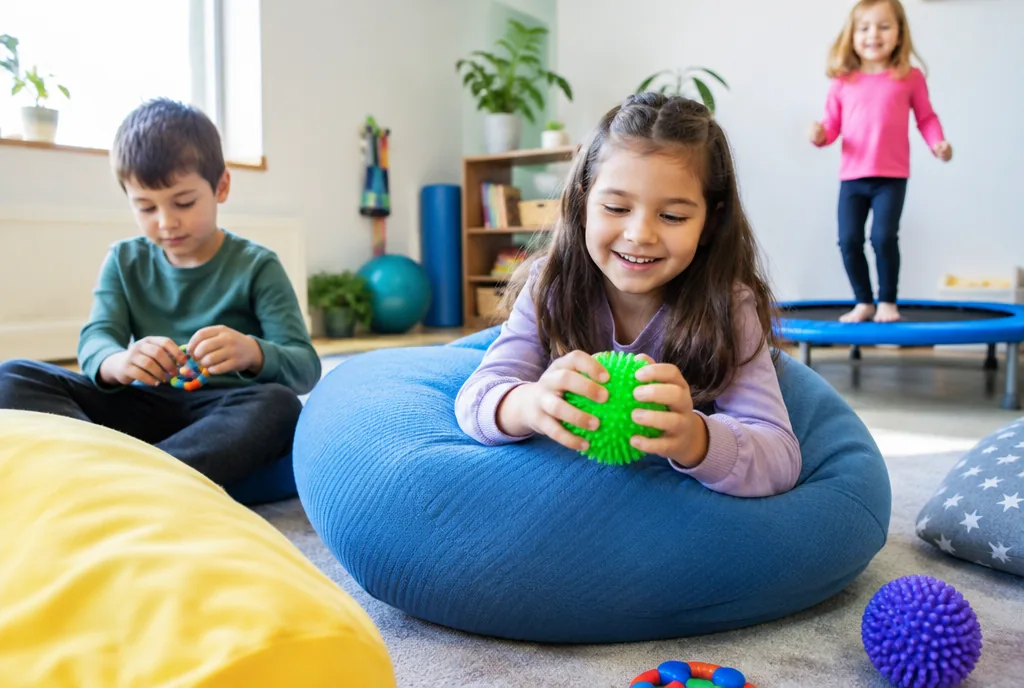
An obstacle course can work on strength, balance, coordination, motor planning, sensory integration, visual-motor skills, and following directions. It also creates repeated chances to practice attention, sequencing, planning, initiation, and finishing a task. Moving “over” cushions and “under” a table gives spatial concepts a physical meaning. When two children share the course, taking turns and solving a blocked route together can also practice cooperation and waiting.
Proprioceptive input comes from active work
Proprioception is feedback from muscles and joints about where the body is in space. A course supplies it through pushing, pulling, carrying, crawling, and jumping. Add a heavy-work stop by having the child carry a backpack with books, push a box, or pull a weighted ball before moving to the next station. Crawling for two to three meters is another heavy-work option. A course that pairs active effort with a clear route can help a child regulate arousal; proprioceptive input may have a calming effect for an overactive child and an awakening effect for an underactive child.
Vestibular input belongs in small, watchful doses
The vestibular system has receptors in the inner ear and works with the eyes and muscles for balance. Balancing on a tape line, walking backward, rolling, and brief head-down positions all bring vestibular input into a course. Combined with proprioceptive input, it is considered especially organizing and regulating in sensory integration. Begin slowly, especially with rolling, spinning, or head-down moves. Too much fast spinning or too many head-down positions can cause nausea or dizziness.
How to keep the course safe
Adult supervision is needed for the entire course. Before each run, remove sharp-edged items, loose cords, and breakables from the play area. Check boxes for staples and remove tape remnants. On smooth floors, skip regular socks: bare feet or non-slip socks are safer. Keep all climbing elements no higher than the child’s body height, and secure cushions so they cannot slide away during a climb or landing. After every run, pause to look for shifted pieces before inviting the next child through.
Stop the activity if a child feels nauseous or dizzy. If symptoms last or keep coming back, or if you have concerns about a child’s motor or sensory development, talk to a pediatrician or occupational therapist. An obstacle course is a play activity, not a diagnosis or a substitute for professional care.
Skip these myths and keep the course useful
- Myth: Bigger is always better. A small course in a hallway can include a crawl, balance, jump, and throw. Fit and sequence matter more than taking over the room.
- Myth: More spinning builds more balance. Fast spinning and repeated head-down positions can cause nausea or dizziness. Start vestibular challenges slowly instead.
- Myth: You need therapy equipment. Boxes, cushions, blankets, chairs, rolled towels, and tape can create a complete course without specialty equipment.
- Myth: Crawling is only for babies. Crawling remains useful for school-age children because it builds trunk stability and shoulder strength, which are a foundation for pencil grasp and fine-motor skills.
Frequently Asked Questions
What should you put in an indoor obstacle course?
Use household items such as pillows and couch cushions, boxes, storage bins, blankets, chairs, stools, and rolled towels. Combine them into stations for crawling, balancing, jumping, and throwing, and arrange the stations in a clear order.
What are simple obstacle courses for kids?
For ages 2 to 3, use three to four stations for less than five minutes: crawl through a box, step over a pillow, and pick up a stuffed animal. Children age 4 and older can work through six to eight stations in sequence.
How do obstacle courses help sensory and motor skills?
They can develop strength, balance, coordination, motor planning, visual-motor skills, and bilateral coordination. Movement also activates proprioceptive, vestibular, tactile, visual, and auditory receptors.
How do you keep an indoor obstacle course safe?
Supervise continuously, clear hazards and cords, secure cushions, remove staples from boxes, and inspect the route after every run. Use bare feet or non-slip socks instead of regular socks on a smooth floor.
When should you see a doctor?
Stop any movement that causes nausea or dizziness, and begin vestibular activities slowly. If symptoms last or keep coming back, or if you have concerns about a child’s development, talk to a pediatrician or occupational therapist.