If you find yourself wondering, “Why does my toddler hit me but not daddy?” you are not alone, and your child is not rejecting you. Around 70% of toddlers display some form of aggressive behavior like hitting between 12 and 36 months, with episodes peaking around the second birthday when big feelings outpace developing vocabularies. When your toddler hits you while staying gentle with dad, it is usually a sign of secure attachment. You are their safest person, which means your child holds their composure together all day and releases pent-up emotional overwhelm right where they feel safest: with their mother.
Why Does My Toddler Hit Me but Not Daddy? The Root Causes
Understanding why toddlers hit starts with brain development. A child’s prefrontal cortex—the area responsible for impulse control and emotional regulation—remains deeply underdeveloped throughout early childhood and does not fully mature until the mid-twenties. Impulse control, meaning the ability to stop a strike before executing it, typically does not develop until ages 3 to 4. A toddler may understand the rule that hitting hurts, yet still lack the neurological ability to hold back when upset.
Everyday physical and emotional triggers spark aggressive behaviors like hitting:
- Emotional unloading: Toddlers hit the caregiver with whom they feel safest, usually the mother, because they can express difficult emotions without fear of rejection.
- Physical depletion: Hunger and fatigue rapidly deplete self-regulation capacity.
- Sensory and environmental overwhelm: Loud noises, bright lights, or crowded settings can push a toddler past their threshold.
- Jealousy: Hitting frequently flares when a mother directs attention toward a sibling.
- High excitement: Hitting does not stem solely from anger; sudden spikes of joy or excitement can also trigger aggressive actions.
- Reactive temperament: Children with intense or highly reactive temperaments experience stronger surges and struggle more with impulse control than naturally easygoing peers.
Sensory Seeking and Proprioception: When Hitting Is Sensory Input
Some children hit, push, or bite because their nervous system actively craves proprioceptive input to self-regulate. Proprioception provides awareness of body position through deep pressure and resistance in muscles and joints. When this sensory demand goes unmet, children often resort to inefficient strategies such as roughhousing, hitting, or biting simply to experience physical resistance.
Conversely, hitting can also be a reaction to sensory overload. A child overwhelmed by bright lights, loud noise, or dense crowds may strike out to discharge unbearable pressure. For tactile defensiveness, some occupational therapists use the Wilbarger brushing protocol with joint compressions, although the approach remains debated. More broadly, implementing a customized sensory diet—combining heavy work, quiet downtime, and active movement—can proactively help reduce hitting episodes, though adjustments typically take weeks to months to show results.
Heavy Work and Physical Outlets to Replace Toddler Hitting
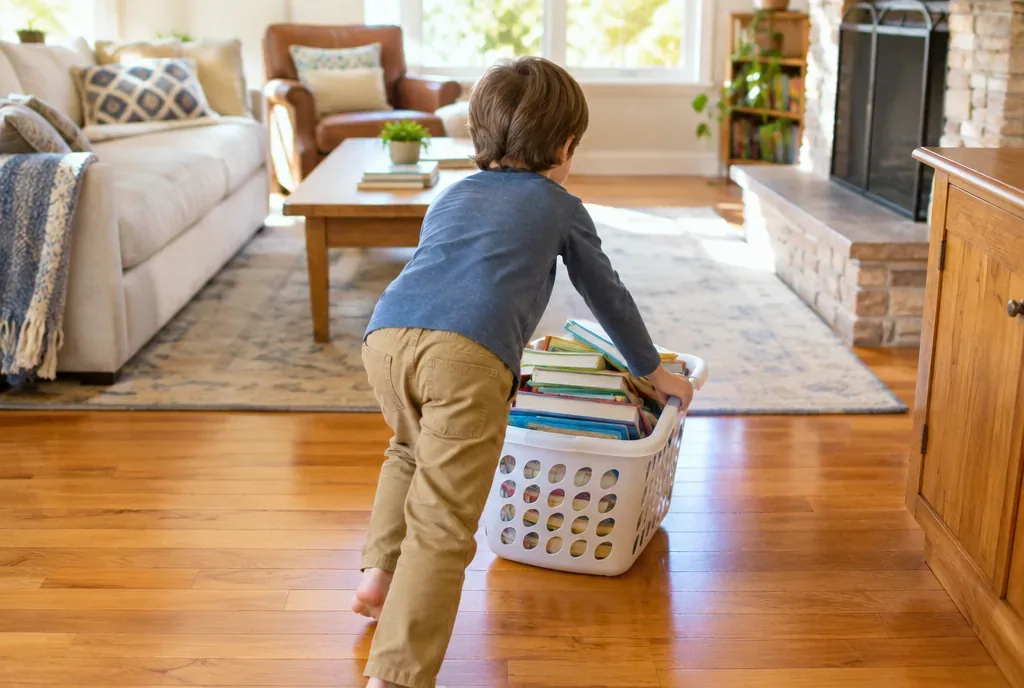
Redirecting physical energy into constructive “heavy work” calms the nervous system and can reduce hitting driven by sensory-seeking needs. Introducing these activities for 5 to 10 minutes before known trigger situations provides a safe outlet:
- Pushing a wheelbarrow: Pushing a toy wheelbarrow or cart offers regulating joint resistance.
- Carrying a heavy basket: Having your child carry or push a weighted laundry basket engages muscles and joints.
- Wall pushes: Have your child place their palms flat against a wall and push firmly.
- Stair climbing: Climbing stairs provides resistance for leg and hip joints.
- Crashing and stomping: Provide safe targets such as a floor trampoline, a drum, or firm cushions where hitting or stomping is allowed.
What to Do When Your Toddler Hits You: A Step-by-Step Response
A parent’s ability to stay regulated is the most effective intervention when a toddler strikes. An adult’s nervous system serves as the dominant signal in the room; children borrow adult regulation before developing their own. Responding with anger or a raised voice only intensifies the child’s aggression.
- Pause and breathe: Take a deep breath to maintain a calm, neutral tone.
- Get down low: Drop into a squat to meet your child at eye level.
- Set a brief, calm boundary: State clearly: “I will not let you hit me. Hitting hurts.”
- Offer an immediate replacement: Teach an alternative script: “Hands are for hugging. Feet are for stomping. Show me your stomp,” or redirect them to hit a pillow.
- Co-regulate and reconnect: Stay near the child rather than isolating them, and offer comfort once the intense reaction passes.
Common Myths About Toddler Aggression
| Common Parenting Myth | Child Development Reality | Recommended Action |
|---|---|---|
| Toddlers who hit want to hurt you or act maliciously. | Babies under 12 months hit out of curiosity to explore cause and effect; 2-year-olds who laugh after hitting are testing boundaries rather than being malicious. | Treat the incident as an immature impulse rather than intentional cruelty. |
| A parent should smack, spank, or hit back to show how it feels. | The American Academy of Pediatrics (AAP) advises against hitting back or spanking, as corporal punishment correlates with worse behavioral outcomes. | Use calm, non-physical boundaries; never hit, smack, or spank a child. |
| Forcing an immediate apology teaches genuine empathy. | Toddlers do not yet possess true empathy, making forced apologies meaningless. | State the concrete consequence calmly: “Carrie is crying now because that hurt.” |
| Labeling the child as “naughty” clarifies wrong actions. | Children internalize shameful labels such as “you are bad” or “you are mean.” | Avoid shameful language and address the behavior directly while maintaining connection. |
| Ignoring repeated hitting allows them to grow out of it. | Passive ignoring confuses toddlers, who need consistent responses to understand boundaries and cause. | Intervene every time with a calm, consistent verbal boundary. |
Proactive Discipline: Spotting Triggers Before Hitting Starts
Two weeks of simple pattern observation can often reveal the top three hitting triggers in your household. Hitting clusters predictably during specific daily windows: the hour before lunch, the hour before bedtime, transitions into loud or unfamiliar settings, or after excessive screen time. Supporting your child with adequate sleep, regular meals, and scheduled movement periods prevents more hitting episodes than reacting in the moment.
Discipline works best when all caregivers remain aligned. When mothers, fathers, and grandparents provide the exact same predictable response, hitting behavior declines faster. Consistency is essential: if a tantrum yielded four extra turns on the slide yesterday but none today, the child will continue testing limits. For pre-verbal toddlers, teaching simple sign language for “help,” “more,” or “stop” reduces the frustration that fuels hitting. During calm moments, practice gentle touch games on stuffed animals or a caregiver’s arm, and use targeted praise (“I like how you used your words”) to reinforce positive behavior.
Addressing Hitting Beyond the Toddler Years: Ages 5, 7, and 10
While hitting during the toddler stage is a common developmental phase, aggressive behaviors in school-age children require different responses:
- At age 5: Enforce calm, clear consequences, such as ending the current game, and guide the child toward physical alternatives like stomping feet or squeezing a stress ball.
- At age 7: If a 7-year-old hits during angry outbursts, help them label the emotion (“You feel completely furious because…”) and introduce verbal expressions such as “I am so mad” instead of using fists.
- At age 10: Avoid inventing massive punishments (such as no games for a month). Instead, choose a proportionate, immediate consequence, such as ending the current activity. If a 10-year-old repeatedly hits, pursue a psychological evaluation to screen for underlying conditions such as ADHD, anxiety, or adjustment disorders.
When to Seek Professional Guidance
Occasional hitting between 12 and 36 months is common, but certain warning signs warrant professional evaluation. Seek guidance if your child hits very hard or targets heads, causes repeated injuries, leaves bite marks or bruises, or shows no awareness that hitting causes pain. Professional evaluation is also advised if aggressive behavior lasts longer than a few weeks, disrupts everyday life (such as removal from daycare or preschool), or co-occurs with extreme fearlessness, severe risk-taking, or an intense drive for sensory stimulation. A pediatrician is the primary point of contact and can provide referrals to a child psychologist, family therapist, or early intervention center.
Frequently Asked Questions
Why does my toddler hit me but not their dad?
Toddlers hit the caregiver with whom they feel safest, typically the mother. It is usually a sign of secure attachment, not rejection. Your child holds their emotions together during the day and releases frustration, sensory overload, and fatigue in your presence because they feel safe expressing difficult emotions with you.
How to discipline a 2 year old when they hit you?
Discipline for a 2-year-old requires calm clarity rather than lectures. State briefly: “No hitting. Hitting hurts.” If a time-out is used, limit it to 2 minutes (such as on a caregiver’s lap or in a playpen) and offer co-regulation by saying “I will help you calm down,” rather than isolating the child. Spanking or hitting back is counterproductive, as it models hitting as an acceptable solution.
My 5-year-old child keeps hitting me. What should I do?
When a 5-year-old hits, respond with calm, clear consequences, such as ending the current game. Guide the child toward safe physical alternatives, such as stomping their feet or squeezing a stress ball.
My 7-year-old hit me when they are angry. What should I do?
If a 7-year-old hits during angry outbursts, help the child label their feelings (“You feel completely furious because…”) and practice alternative phrases like “I am so mad” instead of striking with fists.
What to do when your 10 year old child hits you?
Do not invent severe, disproportionate punishments such as no games for a month. Select a proportionate, immediate consequence, such as ending current activities. If a 10-year-old hits repeatedly, seek a psychological evaluation to screen for underlying issues like ADHD, anxiety, or adjustment disorders.
How long does the toddler hitting phase usually last?
For most children, hitting peaks around the second birthday and declines as language skills develop. In a longitudinal study, many aggressive toddlers stopped hitting frequently between 17 and 29 months. With consistent, calm boundary enforcement, the behavior typically resolves by ages 4 to 5.